
Just now, 9 departments jointly issued a document: accelerating the improvement of service formats such as 'elderly care and childcare' (full text of the opinion attached)
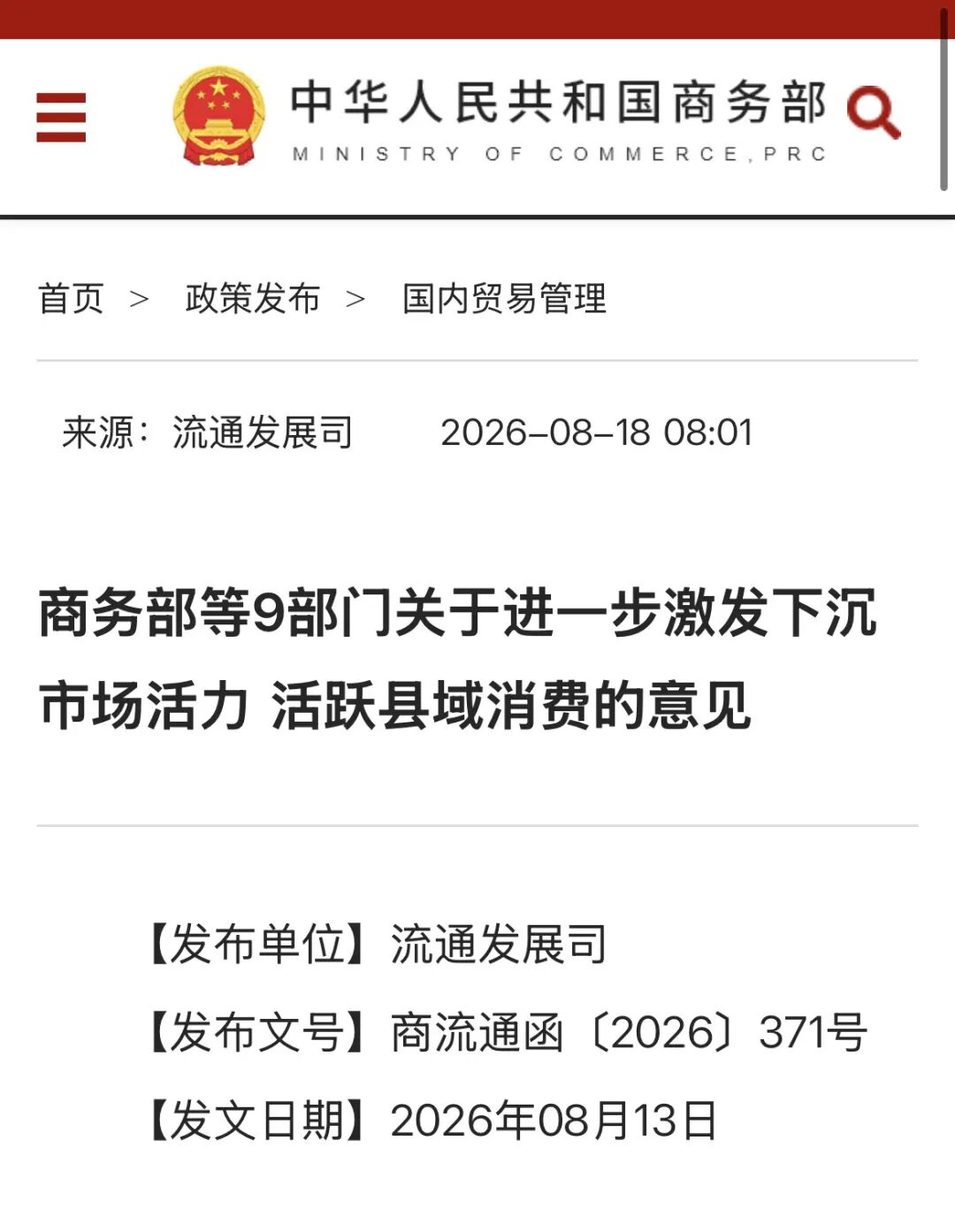
Opinions of the Ministry of Commerce and 8 other departments on further stimulating the vitality of lower-tier markets and invigorating county-level consumption
Shang Liu Tong Han [2026] No. 371
In order to further stimulate the vitality of lower-tier markets, promote the expansion and quality improvement of the service industry, and invigorate county-level consumption, the following opinions are hereby proposed.
I. Overall Requirements
Guided by Xi Jinping Thought on Socialism with Chinese Characteristics for a New Era, thoroughly implement the spirit of the 20th National Congress of the Communist Party of China and all previous plenary sessions, fully leverage the strategic supporting role of lower-tier markets in expanding the incremental space of domestic demand and building a strong domestic market, learn from and apply the experience of the ‘Thousand Villages Demonstration, Ten Thousand Villages Renovation’ project, optimize consumption channels through category-based policies, enrich brand supply, and enhance service capabilities. Create distinctive consumption scenarios tailored to local conditions, continuously prosper the county-level consumer market, and better meet the diverse and high-quality needs of the people.
II. Supporting the Upgrading of County-Level Consumption Channels
(1) Accelerating the renewal of existing commercial facilities.Support the upgrading and renovation of traditional department stores and old shopping malls, and promote the optimized layout of brand chain stores, discount retail stores, and fresh food e-commerce stores. Deepen the ‘thousand markets, ten thousand stores’ renovation and upgrade, support the construction and upgrading of township commercial centers, collection (agricultural) markets, and township specialty fairs, and standardize and regulate the construction and renovation of new convenience stores and village-level logistics comprehensive service stations.
(2) Optimize the layout of commercial outlets.Promote the effective connection between the layout of county-level commercial outlets and territorial spatial planning. Comprehensively consider factors such as existing stock and population trends, combined with assessment and analysis of commercial vacancy rates, and dynamically adjust commercial layout guidelines. Promote the construction of a number of high-energy consumption carriers such as core business districts and specialty commercial streets, rationally lay out a number of large commercial complexes, and introduce domestic and foreign brands to open regional first stores.
(3) Improve commercial service supporting facilities.Coordinate the promotion of commercial space renovation, traffic organization optimization, and supporting facility updates to enhance the radiation capacity of county-level commerce. Promote large circulation enterprises such as postal and supply and marketing cooperatives to extend services to remote areas, and carry out ‘supply and marketing market’ activities. Summarize and apply the ‘Yiwu development experience’, focus on the main functions of each region, build and renovate professional markets and distribution centers combined with local characteristic industries, and enhance the ability of commercial circulation services to support industrial development.
(4) Revitalize idle resources and assets.For the use of existing real estate or land to develop county-level livelihood industries such as elderly care and childcare, a transitional support policy of not changing the land use subject and planning conditions within 5 years can be enjoyed. On the premise of conforming to territorial spatial planning, encourage the promotion of the renovation and development of existing land through various methods such as self-operation, joint operation, and transfer, to improve the level of local commercial services. Support county-level governments to use vacated office buildings and other idle state-owned assets to be converted into convenient commercial outlets. Support rural collective operational construction land to enter the market legally to develop county-level commerce, and encourage the use of idle rural houses to develop new industries and new business forms that conform to rural characteristics.
3. Promote innovation in county-level commercial business formats and brand building
(5) Guide chain enterprises to accelerate expansion into lower-tier markets.Simplify approval procedures for opening supermarkets and convenience stores, and advance the goal of ‘getting things done efficiently in one stop.’ In eligible county-level regions, implement ‘one license with multiple locations’ for chain enterprises and commercial individual businesses. Standardize and optimize approval procedures in areas such as fire safety and market regulation. Encourage state-owned properties to appropriately extend lease terms for commercial projects. No explicit or implicit barriers shall be imposed on the cross-regional operations of chain enterprises.
(6) Promote integrity and innovation of local brands.Develop small shops, time-honored brands, and workshop-style brands that carry local culture, and support the expansion of domestic trendy products into county-level markets. Build a tiered lineup of China’s consumer brands. Support cross-industry collaborations between local county brands and chain brands. Deepen the implementation of the agricultural brand excellence cultivation plan and optimize the agricultural brand catalog system. Intensify the advertising assistance to agriculture initiative and support the allocation of quality advertising resources to lower-tier markets. Further optimize approval procedures such as ‘individual to enterprise’ license joint processing in county areas.
(7) Develop emerging business formats tailored to local conditions.Encourage regions with the right conditions to develop virtual reality, immersive experiences, and ‘AI + consumption,’ and promote green consumption models such as second-hand trading and product rental. Deepen the implementation of special initiatives to promote healthy consumption. Innovate consumption chains that integrate primary, secondary, and tertiary industries.
4. Optimize the supply of goods and services in county areas
(8) Expand the supply of quality goods at fair prices.Encourage enterprises to actively introduce quality goods into county-level markets, and launch new products simultaneously in counties where conditions permit, promoting ‘same quality and same enjoyment’ of identical products in both urban and rural areas. Guide enterprises to develop quality products that suit county-level consumption characteristics, and support commercial circulation enterprises in building flexible supply chains through ‘own brands + production based on demand’. Vigorously support the promotion of new energy vehicles, green intelligent products, and green building materials to rural areas, and expand the coverage of rural charging facilities.
(9) Accelerate the improvement of service formats such as ‘elderly care and childcare’.Encourage localities with the right conditions to support brand catering, accommodation, and other life service enterprises in expanding their markets through measures such as renovation rent subsidies and entrepreneurial financing guarantees.Implement the county-level elderly care service improvement plan. Coordinate existing resources to support the construction of rural regional elderly care service centers and county-level childcare service facilities.Promote the extension of the ’15-minute convenient living circle’ to county-level areas.
(10) Promote the integrated development of commerce, agriculture, culture, tourism, and sports.Support extending the consumption chain through performance and event tickets. Promote the quality upgrade of nighttime cultural and tourism consumption, and create a number of rural tourism destinations with distinctive cultural features. Cultivate special consumption scenarios such as ‘wellness +, cultural tourism +, agriculture +, folk customs +, and historical classics +’, support adjacent counties in jointly creating cross-regional classic consumption routes, and attract more urban residents to spend in rural areas.
V. Further Enhancing the Modernization Level of County-Level Circulation
(11) Improving the Efficiency of Urban-Rural Circulation Networks.Optimize the planning and layout of commercial circulation infrastructure, and unify construction and operation standards as well as management norms. Deepen cooperation between postal and express delivery services, promote the integrated development of rural passenger, freight, and postal services, and accelerate the connection of county-level commercial logistics and express delivery logistics. Improve the agricultural product logistics service system, support the construction of origin warehouses, centralized procurement and distribution centers, cold chain storage and preservation facilities, and field markets, promote standardized pallets and fruit and vegetable turnover boxes (baskets), and strengthen the connection of cold chain services. Deepen the supply and marketing cooperative’s ‘Green Agricultural Materials’ upgrade initiative.
(12) Guiding the Synergistic Development of Online and Offline Channels.Deepen the high-quality development project for rural e-commerce and thoroughly implement the ‘Digital Commerce to Revitalize Agriculture’ initiative. Strengthen the construction of the e-commerce supply chain and expand rural e-commerce application scenarios such as local customs and folklore, intangible cultural heritage skills, and rural cuisine. Encourage supply chain enterprises to provide services such as demand forecasting, logistics optimization, and inventory management to county-level retail entities, and carry out bulk centralized procurement and customization. Guide platform enterprises to consciously regulate pricing and platform subsidy behaviors, and reasonably reduce fees such as commissions and technical service fees for newly settled merchants and small and micro merchants in counties. Coordinate county-level e-commerce public service resources, build a number of ‘Village Broadcaster Academies’, and increase public welfare training efforts.
VI. Strengthening Consumption Support Capabilities
(13) Promoting Stable Employment and Expanding Income-Generating Avenues.Support enterprise headquarters or platform enterprises to establish business outlets and business units in qualified counties, expanding employment capacity. Intensify the implementation of work-relief programs. Coordinate efforts to provide services and guarantees for migrant workers going out for work, as well as support for returning home for employment and entrepreneurship. Encourage the integration of public employment recruitment and county-level consumption special events, and add employment services to qualified county-level consumption venues and convenience service outlets. Encourage localities to include service industry-related occupations in the county-level catalog of urgently needed and scarce talent based on actual conditions.
(14) Strengthen entrepreneurship and housing support to unleash consumption potential.Increase support for the ‘efficient handling of one matter’ initiative for individual entrepreneurship at the county level. Encourage county-level governments to build rural entrepreneurship parks and other incubation platforms for returning entrepreneurs based on local conditions. Promote typical experiences such as ‘common prosperity workshops,’ carry out capacity-building actions for ‘business managers,’ support ‘new artisans’ in fields such as cultural and creative handicrafts, home lifestyle, and food and tea beverages, and cultivate more county-level labor service brands. Support joint marketing between home improvement, home appliance enterprises and real estate developers, and implement city-specific policies to support housing needs of families with multiple children.
VII. Strengthen factor integration and business environment development
(15) Strengthen fiscal fund guarantees.Implement actions to activate consumption in lower-tier markets, focusing on supporting consumption channel upgrades, scenario innovation, and efficiency improvement in county areas, and filling gaps in life services. Optimize resource allocation, coordinate central and local funding channels, integrate and utilize existing resources, and build service facilities in county areas for elderly care, childcare, education, healthcare, sports, and other fields based on local conditions. Support eligible personal consumption loans and loans for service industry business entities to receive fiscal interest subsidy support.
(16) Improve the quality and efficiency of financial services.Guide financial institutions to optimize financial services in the consumption field of lower-tier markets, and strengthen financial support for eligible consumer commercial facility projects. Support eligible wholesale, retail, and service consumption enterprises to issue bonds and list for financing. Eligible commercial circulation enterprises that newly open chain stores in county areas may apply for entrepreneurial guarantee loan policies and receive interest subsidy support.
(17) Strengthen guarantees for commercial land use in county areas.For circulation enterprises laying out logistics, warehousing, cold chain and other facilities in county areas, mixed-use land supply may be implemented in accordance with planning, and flexible-term land transfer may be adopted based on enterprise willingness. The base price for county-level logistics, warehousing, and cold chain land may be determined with reference to the market land price level and benchmark land price of industrial land in the relevant region. County-level industrial land may accommodate supporting administrative office and living service facilities not exceeding 15% of the total floor area above ground, providing convenient commercial services, and shall not be separately divided or transferred. Qualified localities are encouraged to explore short-term land development and utilization, allowing temporary changes in the use of premises to provide commercial services, with land transfer income paid in accordance with the law.
(18) Create a favorable consumption environment.Promote all localities to strengthen statistical monitoring of county economic and social development to facilitate enterprise investment decisions. Encourage the establishment of a number of consumer rights protection service stations and cultivate a number of trusted business districts, markets, streets and other agglomeration areas. Urge platform enterprises to strengthen review of business operator qualifications, intensify verification of commodity information, and improve rapid handling mechanisms for consumer disputes. Continue to crack down on vulgar livestream selling, illegal advertising and other acts, and do a good job in the supervision of recalls of consumer goods sold online.
The Ministry of Commerce shall decompose and refine task arrangements on an annual basis, and strengthen inter-departmental coordination and supervision and guidance. All localities should actively explore county-level consumption development models that suit local characteristics.
Ministry of Commerce National Development and Reform Commission Ministry of Finance
Ministry of Human Resources and Social Security Ministry of Natural Resources Ministry of Agriculture and Rural Affairs
Ministry of Culture and Tourism State Administration for Market Regulation National Financial Regulatory Administration
August 13, 2026
(This article has been abridged)
|
Source: Ministry of Commerce official website Disclaimer: This platform is dedicated to industry sharing and exchange, and the articles do not represent the platform’s views. The copyright belongs to the original authors. If there are errors in the source attribution or infringement of your legitimate rights and interests, please contact us, and we will promptly correct or delete them. Thank you. |
The 9th China Senior Care Industry Lujiazui Summit
The 9th China Senior Care Industry Lujiazui Summitwill be held as scheduled on September 15-16, 2026, at the Shanghai International Convention Center. This summit focuses onfour major themes: ‘Keynote Speeches’, ‘Quality Operations’, ‘Long-Term Care Insurance’, and ‘Silver Economy’, inviting over 40 industry experts to deliver practical speeches, and is expected to attract more than 1,000 industry representatives from various regions, with over 60% being operations management and silver economy decision-makers. This is not a generic industry gathering, but an annual forum for core forces.
Eight years of dedication, worthy of a meeting at greater heights.Sign up now, and meet at the summit.