
Latest! National Health Commission: Implement health management services for the elderly and children

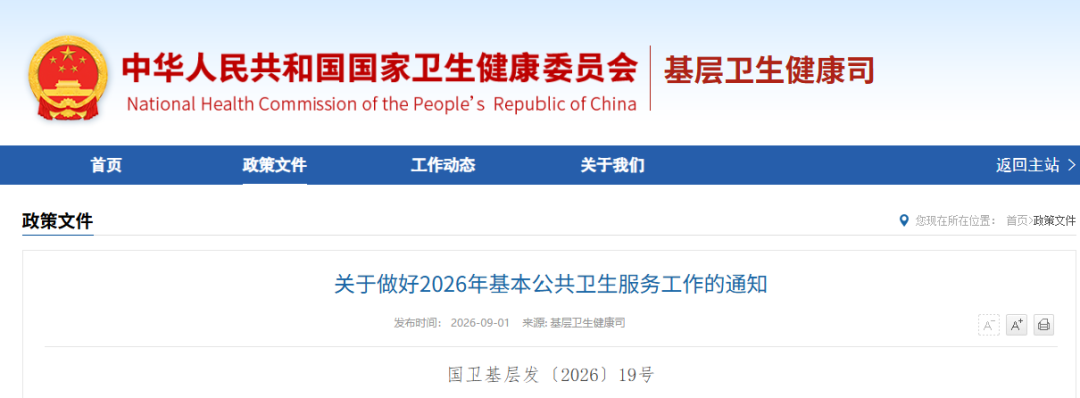
Notice on the Implementation of Basic Public Health Service Work in 2026
Health Commissions, Finance Departments (Bureaus), Traditional Chinese Medicine Administrations, and Disease Control Bureaus of all provinces, autonomous regions, municipalities directly under the Central Government, and the Xinjiang Production and Construction Corps:
In order to thoroughly implement the spirit of the 20th National Congress of the Communist Party of China and the plenary sessions of the 20th Central Committee, promote the implementation of the health-first development strategy, adhere to a focus on primary-level institutions, prioritize prevention, and place equal emphasis on traditional Chinese and Western medicine, implement the ‘Implementation Plan for Strengthening the Foundation of Medical and Health Services’, and promote more inclusive and accessible basic public health services, the following notice is hereby given regarding the implementation of basic public health service work in 2026:
I. Regarding Funding Subsidy Standards
In 2026,the per capita fiscal subsidy standard for basic public health service funds will be 99 yuan. All localities should, in accordance with the requirements of the ‘Notice of the Ministry of Finance and the National Health Commission on Issuing the Budget for Basic Public Health Service Subsidy Funds in 2026’ (Cai She [2026] No. 44) and the ‘Notice of the Ministry of Finance, the National Health Commission, the National Administration of Traditional Chinese Medicine, and the National Disease Control and Prevention Administration on Printing and Distributing the Measures for the Management of Basic Public Health Service Subsidy Funds’ (Cai She [2026] No. 56), promptly decompose and issue performance targets, fully implement and standardize the management and use of funds. Implement the deployment requirements of the Party Central Committee and the State Council on establishing a normalized mechanism to prevent poverty relapse and promote comprehensive rural revitalization, focusing on areas such as national key counties for rural revitalization assistance, do a good job in newborn disease screening and child nutrition improvement, and enhance the equalization level of basic public health services.
2. Strengthen publicity of basic public health services and increase awareness
Through traditional media such as television, radio, and newspapers, as well as websites and new media terminals, widely publicize the equalization service policies of basic public health and the health service content for key populations. Clarify that all promotional materials for various health services supported by basic public health service subsidy funds should be marked with the words ‘Basic Public Health Services’. Give play to the role of village (resident) committees and their public health committees, strengthen coordination with the grid in the jurisdiction, and promptly push information on the time, location, service targets, and content of basic public health services provided by medical and health institutions to villages (communities) and village (resident) members. Guide the public to actively participate in self-health management and be the first person responsible for their own health.
3. Strengthen the concept of proactive basic public health services
Guide medical staff in primary medical and health institutions, in conjunction with family doctor contract services, to proactively enter villages, communities, buildings, and households, provide targeted health education based on population characteristics, and provide standardized health management services for key populations. Strengthen science popularization to increase vaccination willingness, and in conjunction with practical matters for the people in the health system, promote township health centers and community health service centers to provide weekend vaccination services,do a good job in influenza vaccination for key populations including people aged 65 and above in rural areas and primary and secondary school students in compulsory educationStrictly implement the National Immunization Program Vaccine Childhood Immunization Schedule and Instructions (2026 Edition), and standardize the delivery of national immunization program vaccination services.Optimize service delivery to provide human papillomavirus (HPV) vaccination services for eligible school-age girls.Provide Japanese encephalitis vaccination for eligible children in Tibet, Qinghai, Xinjiang, and the Xinjiang Production and Construction Corps.
4. Improve the quality and effectiveness of chronic disease health services at the primary level
Promote the establishment of an information sharing mechanism between the leading hospitals of compact medical consortia or higher-level hospitals and primary healthcare institutions in their jurisdictions, smooth the channels for upward and downward referral, and promptly aggregate and push information on patients with confirmed and stable chronic diseases such as hypertension, type 2 diabetes, and chronic obstructive pulmonary disease, as well as individuals aged 65 and above with disability or cognitive impairment, to the primary healthcare institutions where they reside, based on residents’ wishes. Gradually advance classified and graded health management for chronic disease patients,classify chronic disease patients into red, yellow, and green categories based on factors such as age, blood pressure and blood glucose control status, and the occurrence of complications, and provide graded health services, optimize the frequency and content of services, and concentrate limited resources on strengthening the management of high-risk patients. Strengthen training on relevant service standards and guidelines, and standardize the delivery of health management services. Continue to promote the integration of primary-level guidance points on diet and exercise for hypertension, type 2 diabetes, hyperlipidemia, and obesity (hereinafter referred to as the guidance points) into the physician workstations or corresponding diagnosis and treatment information systems of primary healthcare institutions, with coverage reaching more than two-thirds of township health centers and community health service centers by 2026. Intensify efforts to publicize and promote the application of the guidance points, and provide timely lifestyle intervention guidance to corresponding patients. Continue to do well in the management services for patients with severe mental disorders and the prevention and control of key endemic diseases.
5. Solidify health management services for ‘the elderly and children’
Standardize health checkups and Traditional Chinese Medicine (TCM) constitution identification for residents aged 65 and above. Feedback results in a timely manner through residents’ electronic health records and other means. For health issues identified during checkups, provide targeted health guidance, consultation, or referral recommendations. In line with residents’ wishes, reasonably carry out chest digital radiography (DR) anteroposterior examination for the elderly. The leading hospital of a compact medical consortium should strengthen guidance and quality control for primary healthcare institutions conducting health checkups for the elderly.Conduct preliminary vision and hearing assessments, and continue cognitive function screening. Implement health management services for children aged 0-6, strengthening physical examinations, scientific feeding (reasonable diet) guidance, psychological and behavioral development assessments, vision screening, and TCM healthcare services. In accordance with the requirements of the National Basic Public Health Service Standards (Third Edition) and corresponding technical specifications, equip with safe, simple, and appropriate follow-up devices, strengthen training for medical staff, improve follow-up quality, and ensure the safety of key service targets such as children. Strengthen fertility support by adjusting the target population for pre-pregnancy eugenics health checkups and folic acid supplementation to prevent neural tube defects to urban and rural residents, and integrate these with newborn disease screening and thalassemia prevention and control projects into a eugenics and child-rearing service project (service specifications to be issued separately). Implement projects to optimize fertility policies, and carry out publicity and services for optimizing fertility policies.
VI. Strengthen evaluation and supervision of basic public health services
Implement local fiscal authority and expenditure responsibilities, and manage and use basic public health service funds well. Strengthen penetrating supervision of basic public health services, focusing on residents’ sense of gain and accessibility, service effectiveness, the match between costs and benefits, management of key populations and key diseases, the sufficiency of fund allocation, the timeliness of fund implementation, and whether there is interception or misappropriation. Leverage the guiding role of performance evaluation, strengthen service outcome evaluation, link evaluation results with fund allocation, and mobilize the enthusiasm of medical staff in providing services.
VII. Explore the integrated application of digital intelligence technology and basic public health services
Localities may, based on actual conditions, explore the application of medical artificial intelligence-assisted technology in disease screening, constitution identification, follow-up management, health assessment, health education, performance evaluation, and public satisfaction surveys for urban and rural residents, to reduce the burden on grassroots work and improve residents’ service experience. Localities may, based on actual needs, explore automatic collection of follow-up results through smart devices and real-time aggregation into residents’ electronic health records. Comprehensively promote the safe and orderly opening of residents’ electronic health records to individuals, and by 2026 basically achieve full coverage of electronic health records opened to residents at the county (city, district) level. Focus on improving the data quality of electronic health records and convenience services, and strengthen information security.
National Health Commission Ministry of Finance
National Administration of Traditional Chinese Medicine National Disease Control and Prevention Administration
July 28, 2026
|
Source: National Health Commission, Primary Health Department Disclaimer: This platform is dedicated to industry sharing and exchange, and the articles do not represent the platform’s views. The copyright belongs to the original authors. If there are any errors in the source attribution or infringement of your legitimate rights, please contact us, and we will correct or delete them promptly. Thank you. |
The 9th China Senior Care Industry Lujiazui Summit
The 9th China Senior Care Industry Lujiazui Summitwill be held as scheduled on September 15-16, 2026, at the Shanghai International Convention Center. This summit focuses onfour major themes: ‘Keynote Speeches’, ‘Quality Operations’, ‘Long-Term Care Insurance’, and ‘Silver Economy’, and has invited over 40 industry experts to deliver practical speeches. It is expected to attract more than 1,000 industry representatives from various regions, with over 60% being senior executives in operations management and the silver industry. This is not a generic industry gathering, but an annual forum for core forces.
Eight years of dedication, worthy of a reunion at greater heights.Sign up now, and meet at the summit.