

JD Research Institute Releases the 2026 Panoramic Report on Family Elderly Care Life
Foreword:They are no longer people ‘waiting to be cared for,’ but people actively arranging their own later years
Li Jianhua, over eighty years old, had knee replacement surgery two years ago. He walks with difficulty and can’t stand steadily in the shower. His wife wanted to lend a hand, but he wouldn’t let her; his children said they wanted to move in to care for him, and he refused outright: ‘I’m not at that point yet.’ Later, his son prepared a shower chair for him and quietly arranged bathing assistance service, with a professional coming to the home once a week. After a few times, he gradually accepted it: ‘No need to trouble my wife, and no need for the kids to run over…’
Zhou Mingyuan, a seventy-year-old retired engineer, lives alone. His daughter works out of town year-round, and a weekly video call has become a fixed arrangement for the two of them. But video calls can’t solve everything—what worries him most is going to the hospital: registering, paying fees, picking up medicine—after the whole process his legs feel weak. His daughter booked him an medical escort service online and also hired a housekeeping lady once a week, and while at it, installed emergency call buttons throughout the home. Now life is much more secure than before. ‘It’s not that I’m incapable—it’s just an extra layer of protection, and the kids can rest easy.’
…
Scenes like this are happening in more and more families. Such stories are not scripts of ‘the elderly needing to be saved,’ but examples of ‘the elderly actively embracing and choosing a better way of life.’ Over the past year, we interviewed more than 10,000 families and completed 576 specialized surveys with home-visit nurses and a number of eldercare workers who have long been rooted in the front lines. We witnessed a significant shift that is taking place:Older adults and their families are both actively seeking out and trying new approaches to make later life with home-based eldercare more relaxed and with a greater sense of control.
In-home bathing assistance, home cleaning, medical appointment accompaniment, medical nursing, age-friendly home modifications… More and more specialized eldercare services are entering the home, quietly reshaping the later lives of older adults.
01
Changing Perspectives:
From ‘Raising Children for Old Age’ to ‘Independent Aging’
Seniors Say: I Want to Do It Myself, But I Don’t ‘Overdo It’
64.4% of seniors prioritize aging in place—not because they have no choice, but because a familiar home and familiar surroundings are what make them feel at ease and secure; 57.7% of seniors explicitly state they want to burden their children less and do things themselves whenever possible.Views on aging are quietly diverging: nearly half of seniors (45.2%) want to stay in their familiar homes and retain control over their lives, with community and home services lending a hand; over one-third (35.0%) still expect care from their children, but this proportion is lower than the former. The millennia-old notion of ‘raising children for old age’ is gradually shifting toward ‘independent aging.’ (Survey 1)
Some seniors express it this way: ‘There’s no need for the whole family to revolve around me, and no need to do everything for me—I don’t want to be treated as a patient needing full care. When I can’t keep up physically with certain things, having some services lend a hand is enough; I want to be in charge of my own life.’ These words reveal the self-respect of older adults and a pragmatic wisdom—they are not refusing help, but actively choosing the way they are helped: self-reliance as the foundation, services as the safety net, keeping the initiative of later life in their own hands.
Children Say: The Essence of Filial Piety Is Giving Parents a High-Quality Later Life
The essence of filial piety is giving parents a high-quality later life—this is the consensus of most children.
Mr. Lin, 46, had long been troubled by one thing: his father’s knees had deteriorated and walking was difficult, and bathing at home was full of hidden risks. Every time he came home on leave, helping his father wash was like walking on thin ice—he had to guard against slips and worry about catching cold, and both father and son ended up exhausted each time. On his own, it was hard to do it safely. Later, he booked a professional in-home bathing service. Mr. Lin said with emotion: ‘A professional comes to the door to help Dad bathe safely, solving the hardest part, so I can just focus on chatting and taking walks with him.’
When it is difficult to solve the caregiving problems of the elderly, purchasing professional elderly care services is considered the most feasible solution by respondents; the younger generation is protecting their elders in a more efficient and rational way.
After the Spring Festival, 56.1% of the elderly returned to living alone, but this time it was different
After the brief reunion during the Spring Festival, more than half of the elderly return to living alone or with a spouse. But unlike the past, living alone today no longer means isolation: one-touch call devices, regular weekly housekeeping visits, on-demand medical accompaniment services, video calls available at any time… A safety net woven from professional services allows the elderly to live with peace of mind even behind closed doors, and gives their children peace of mind even when they are not by their side.
02
Family actions:
Over 70% of families are ‘buying services’ for a better later life
72.4% of families want to add professional services for the elderly
It is not driven by circumstances, but more by a proactive upgrade in quality of life.
Family caregiving always has boundaries in physical capacity and professional expertise that are hard to overcome, and this is precisely where professional elderly care services begin.
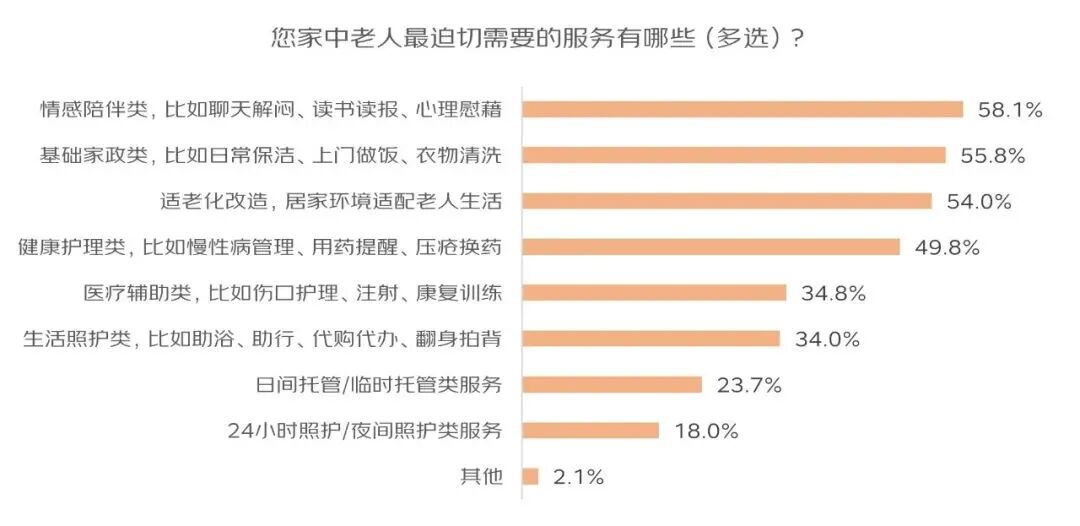
The five most urgent needs:
-
Emotional companionship (58.1%) — what older adults want is not someone to do chores, but someone to talk with and keep them company.
-
Basic housekeeping (55.8%) — cleaning and cooking, freeing up physical energy and leaving time for things they enjoy.
-
Age-friendly home modifications (54.0%) — installing grab bars, anti-slip measures, and call buttons is like adding ‘airbags’ for independent living.
-
Professional nursing care (49.8%) — dressing pressure sores and tube care, allowing older adults to receive medical-grade care at home.
-
Daily living care (assisted bathing, etc.) — bathing may seem like a small thing, but professional services can help older adults bathe cleanly, safely, and with dignity. (Survey 1)
Today’s home-based elderly care services already cover every aspect of seniors’ daily lives. There are basic daily care services such as meal assistance, cleaning assistance, bathing assistance, and medical assistance, which solve the most practical everyday challenges of eating, bathing, and seeing a doctor; there are also health management services such as home health checkups, chronic disease management, and rehabilitation training, and even professional home medical and nursing care such as tube care, skin care, and injections and medication administration. In addition, age-friendly home modifications, one-touch emergency call systems, and smart monitoring shore up home safety; emotional companionship, psychological counseling, and cultural and recreational activities look after seniors’ inner world.
The four most anticipated directions: monitoring, safety, care, and companionship
Even as services become ever richer, there are still many needs that are not fully met. When asked which services seniors need most but are still hard to find adequate provision for, the children’s answers were highly consistent:Health monitoring and reminders (53.5%), home safety and convenience support (47.5%), professional medical and care services (47.4%), and emotional companionship and socializing (45.7%).These unmet gaps in demand are precisely the room for growth for new elderly care services and models. More and more platforms, communities, and practitioners are entering the field, gradually turning services that many families ‘wanted but could not find’ into home-based elderly care solutions where ‘someone provides them, and provides them well.’ (Survey One)
03
Five levels of care:
Every level has a solution, and every situation can find support
The circumstances of older adults vary, and so do the challenges of home care. From independent living alone to advanced age and mild, moderate, and severe disability, domestic care services are developing tiered solutions so that no matter what stage an older adult is in, they can find support that fits.
Older adults living alone: one more layer of security, one more measure of freedom
55.8% need accompanied medical visits, and 46.7% need cleaning assistance.
The core need of older adults living alone is to fill the gap of ‘having no one to lend a hand.’ The demand for accompanied medical visits is the highest at 55.8%; with someone accompanying them to the hospital, handling registration and consultations, and paying fees and picking up medicine, the anxiety of seeking medical care alone can be greatly eased. 46.7% of households need cleaning assistance to take care of chores such as cleaning and laundry; nearly 40% of households need meal assistance, including cooking at home, buying groceries on their behalf, and meal delivery.(Survey 2)
For older adults living alone, ‘something happens and no one knows’ is the greatest worry in their children’s minds, which also makes them more dependent on stable, regular home services. The survey shows that 30.7% of households choose specialized services at a fixed weekly frequency for older adults living alone, and 29% prefer fixed home visits of 1–2 hours every day. A stable service rhythm can gradually build trust while also providing both daily life care and mild emotional companionship.
Services are ‘filling in’ the gap where older adults living alone need a helping hand: if the refrigerator breaks, someone fixes it; if a light bulb burns out, someone replaces it; if they go to the hospital, someone accompanies them. The daughter of one older adult living alone said: ‘My mom lives on her own now, but I am not worried at all. She has a call button, a housekeeper who comes every week, and accompanied medical visits available on call. She lives more comfortably than she did with me.’
Advanced-age older adults: unable to manage, but with help at hand
58.4% need medical accompaniment, 48.9% need housekeeping assistance, and 47.4% need emergency call services.
The physical strength of elderly seniors continues to decline, and many things gradually become beyond their capacity. They cannot understand the procedures at hospitals and cannot endure long queues; housework such as cleaning and laundry becomes increasingly difficult to complete independently. Coupled with poorer balance and slower reactions, a single fall could completely change their ability to care for themselves. Among the children of families with elderly seniors,58.4% believe that the elderly at home most need medical accompaniment services, followed by housekeeping assistance services (48.9%). These two types of services take over the daily trivial matters that elderly seniors find beyond their capacity, sparing them from rushing about and toil; the installation of emergency call buttons and 24-hour response (47.4%), as well as regular in-home safety inspections (42.5%), directly move the line of defense forward, shifting from passive response to proactive hazard detection.(Survey II)
Aunt Fang Yizhen from JD Housekeeping has served Grandpa Jiang and Grandma Lü, who are over 80 years old, for more than three years. From the first trial visit to twice-monthly regular cleaning, the two elderly people have long regarded her as family, affectionately calling her ‘our dear daughter’ and even circling the days of her visits on the calendar with great anticipation. She deeply understands that the biggest difficulty for elderly seniors in doing housework is not wiping tables and sweeping floors, but bending down and squatting: the clutter under the sofa and beneath the coffee table is something the elderly cannot squat down to reach. Every time she visits, she specifically cleans these dead corners. Fang Yizhen says that serving elderly households requires not only adhering to standardized procedures but also understanding and empathizing with the elderly’s feelings, focusing on helping them complete housework they cannot manage, such as climbing high and squatting down. Grandpa Jiang often remarks that in an aging era, more such considerate housekeeping workers are exactly what is needed.
Elderly people with mild disability: ‘I can still manage on my own,’ but with professional assistance they would be more at ease
61.4% need housekeeping assistance, 60.9% need medical accompaniment, and 57.5% need bathing assistance.
Elderly people with mild disability can independently complete most basic activities in daily life, but in certain complex or physically demanding activities such as seeking medical care and bathing, they need assistance from others. At the same time, they have a strong sense of self-esteem and desire for autonomy, and do not want to be treated as patients who are completely dependent on care. Helping to fill the gaps in their daily lives is the core demand.Assistance with cleaning (61.4%) and accompaniment to medical appointments (60.9%) are the two types of life-care services older adults need most. The former addresses the household difficulties brought on by declining physical strength, while the latter solves the mobility barriers of going out to see a doctor. Demand for bathing assistance accounts for 57.5%; bathing is not only a matter of cleanliness but also one of the highest fall-risk scenarios in the home setting—it concerns both safety and dignity.(Survey 2)
“Dad, your legs aren’t what they used to be—let me help you wash.” “No need, no need. You go do your work; I’ll do it myself in a bit.” Whenever Ms. Yang cleans the bathroom, she always pictures her father’s trembling, cautious manner when he bathes. The old man puts on a brave front, simply wanting to hold on to the last bit of independence he has. This time she has to go on a business trip and is uneasy about leaving her father home alone, so she booked an in-home bathing service. She carefully instructed the caregiver: “My father injured his leg, so it’s inconvenient for him to bathe and change his dressing, and his memory isn’t great either. Please talk with him more.” Someone to catch that stubborn “you go do your work” from the old man—and the worry weighing on the children’s minds finally has somewhere to rest.
Moderate disability: professional care, so family members no longer have to bear it alone
57.1% need continence care, 52.3% need assistance with transfers, and 52.3% need nighttime care.
The daily care of these older adults faces four unavoidable “mountains”: difficulty bathing (60.4%), laborious transfers (56.6%), exhausting nighttime care (53.1%), and inconvenient toileting (52.6%). Each one tests the caregiver’s physical strength, endurance, and professional skill.Their most urgent service needs center on basic physiological care, personal safety, and the preservation of personal dignity, including toileting and continence care (57.1%), assistance with transfers (52.3%), nighttime care (52.3%), and bathing assistance (51.2%). For meal assistance, what matters more is “safe eating”: 65.0% need special meals such as soft or pureed food, 63.1% need professional nutritional assessment, and 61.2% need supervision to prevent choking while eating. The bathing scenario relies more on the combination of physical facilities and professional capability: barrier-free renovation of the home bathroom (30.7%) and regular professional in-home bathing assistance (29.1%) are the core ways to reduce bathing risks and ensure cleanliness quality. (Survey 2)
Hati, a young man from Xinjiang born in the 2000s, is a home-based elderly care provider at JD Housekeeping. He has provided door-to-door bathing assistance to more than 300 elderly people. Every time he visits, he brings a full set of professional equipment: first assessing the person’s physical condition and adjusting the room temperature, then washing at a constant temperature while chatting with the elderly as he cares for them, and finishing with a simple rehabilitation massage. Through frontline service, he understands that for bedridden elderly people, bathing is far more than cleaning. With long-term limited mobility, a proper bath becomes a luxury, and they long even more to be treated as equals and to keep their dignity. He has also witnessed the industry’s upgrade firsthand: in the past, people only wanted someone to come and provide the service, but now they prioritize professional competence; the spread of methods such as air-cushion bed bathing allows bedridden elderly people to clean their bodies cleanly and with dignity. In Hati’s eyes, bathing assistance washes away not just dirt, but helps the elderly preserve the dignity of life, and this job also gives him a strong sense of value.
Severe disability: round-the-clock care, preserving dignity and respect
66.7% need continence care, 56.5% need pressure sore prevention, and 56.5% need passive limb movement.
This group has the heaviest needs, but services are keeping up too: electric nursing beds, anti-pressure sore air cushions, smart monitoring mattresses, home-visit nurses… The son of a severely disabled elderly person said: ‘My mother can’t speak anymore, but when the caregiver turns her over gently, you won’t see her shed tears. Caregivers came and went one after another, and the one who stayed in the end was very patient.’
Difficulty getting up and transferring (71%), cumbersome bed continence care (68.1%), high risk of pressure sores (60.1%), and strenuous turning (59.4%) are the most prominent pain points in the care of severely disabled elderly people.Facing such care pressure, fixed-frequency specific services each week (40.6%), 24-hour live-in caregivers (26.1%), and the combined model of ‘family night shift + day shift caregiver’ (23.9%) are the service models chosen by more surveyed families. This type of care places high demands on caregivers: it requires both professional competence and stable companionship and sufficient patience, safeguarding the elderly person’s dignity and respect.
In terms of service needs,Continence care (66.7%) is the primary essential need; diaper changing and cleaning are the most frequent and urgent daily care tasks, directly related to the elderly person’s hygiene, comfort, and infection prevention. Close behind are pressure sore prevention and care (56.5%) and passive limb movement (56.5%). Pressure sores, muscle atrophy, and joint stiffness are the most common complications of long-term bed rest, and preventive care is far more meaningful than remediation afterward. Bed sponge baths or professional bathing assistance (55.8%) and scheduled turning (54.3%) also exceed half.The same applies to bathing assistance scenarios: 53.6% of families need professional service personnel to provide in-home bed bathing and skin care, as ordinary cleaning cannot meet the care requirements of bedridden elderly individuals. (Data sample: Survey 2)
04
Age-friendly renovation:
It’s not decoration; it’s installing a ‘growth system’ for the home
Age-friendly renovation is not a one-time renovation project, but rather synchronizing the house with the elderly person’s changing physical condition, creating a home safety system that can evolve over time. Elderly people with different physical conditions face different home risks, and the focus of renovation varies accordingly.
Elderly living alone/advanced age: fall prevention is the top priority Elderly with mild disability: removing obstacles is most important
Advanced-age elderly individuals experience declining mobility and a significantly increased risk of falls, while sudden emergencies involving those living alone are difficult to detect in time. In the survey, no one noticing or taking them to the hospital in time during a sudden illness, and slipping and falling, were the two most prominent family concerns; therefore,fall alarms/gas leak alarms, installation of grab bars in bathrooms and shower areas, anti-slip flooring renovation throughout the home, and emergency call buttons or pull cords are the most urgently needed renovation items.The significance of these renovations is not ‘preventing aging,’ but enabling older adults to ‘dare to walk, dare to move, and dare to live independently.’ (Survey 2)
The home challenges faced by older adults with mild disabilities are concentrated in fear of slipping while bathing (47.3%), easily falling when getting in and out of bed or going up and down stairs (45.5%), easily tripping when getting up at night (41.9%), and unstable walking requiring support (41.8%). The survey also found that 30.2% of older adults resist assistive devices such as grab bars out of self-esteem, thinking to themselves, ‘I can do it myself, I don’t need these things.’ Therefore, for renovations targeting older adults with mild disabilities, the core is to eliminate movement obstacles in the home environment, so they can enter and exit the bathroom independently and move around the home steadily, minimizing dependence on others and preserving control over their lives.In the survey, their most core renovation needs are installing simple grab bars in areas such as bathrooms and hallways (63.6%), followed by simple anti-slip renovation of floors throughout the home (52.1%), adding shower chairs in bathrooms (51.9%), and simple assistive devices such as walkers (51.6%).The key to renovation lies in this: the hardware must not look like cold medical equipment. Good age-friendly design is something older adults are willing to actively use and accept over the long term. (Survey 2)
Chen Jianguo, a 73-year-old retired teacher, suffered a mild cerebral infarction half a year ago that left him with slight residual clumsiness in his left limbs. His children proposed moving in to live with him, but he refused outright; when the family wanted to install grab bars in the bathroom, he also blocked it. Later, his daughter came up with an idea: she chose a minimalist grab bar in the same color family as the bathroom tiles, and also bought a shower chair that looked like a lounge chair, saying, ‘It’s for you to sit and rest while bathing, not some medical device.’ Chen Jianguo said nothing, but used it very often. ‘It’s not that he doesn’t need it, it’s that he doesn’t want to be treated as a patient,’ his daughter said. ‘With the right approach, he can use it and still keep his dignity.’
Households with older adults with moderate disabilities: centered on the three matters of transfer, toileting, and bathing
For older adults with moderate disabilities, moving from bed to wheelchair, bathing, using the toilet, putting on and taking off clothes… these most basic actions all require assistance from others, and age-friendly renovations need to precisely address the most core scenario needs. The survey shows thatmobility assistive devices (51.2%), mobile toilets (50.9%), bathing assistive facilities (50.7%), and whole-home safety facility renovations (50.1%) are the age-friendly renovation items with the highest demand.It is worth noting that the renovation needs of these families are very practical, prioritizing the removal of barriers in the three core scenarios of ‘transferring, toileting, and bathing,’ rather than generalized whole-home renovation. In addition, the need for accessibility renovation (48.2%) cannot be ignored: widened passageways and threshold-free floors are the basic conditions for wheelchair access and the prerequisite for other renovation measures to be effective. (Survey 2)
Li Zhaolin, 76, lost the use of his right limbs after a cerebral infarction. The most grueling part is the daily ‘three big tasks’: moving from bed to wheelchair, using the toilet, and bathing. On the few meters from the bedroom to the bathroom, his 72-year-old wife would drag and support him, and several times the two nearly fell together. Later, transfer grab bars, a mobile commode chair, and a shower seat were installed at home, giving the three tasks a ‘helper.’ His wife no longer has to bear the strain, and Lao Li no longer lives in constant fear.
Families with severely disabled older adults: building a system around ‘one bed’
When an older adult becomes severely disabled, basic life activities such as eating, turning over, excretion, and sponge bathing almost all depend on external assistance. Therefore, the core of age-friendly renovation is no longer installing a few grab bars or fixing a few slippery spots, but building a complete system of care-rehabilitation-excretion-pressure sore prevention around the ‘bed,’ and using smart monitoring devices to create an all-weather safety response network.Among age-friendly hardware needs, electric nursing beds rank first with a 62.3% demand share. A multifunctional nursing bed integrates excretion, position change, daily care, and other functions, making it the most core hardware investment for these families; next are toilet facility renovation (51.4%), anti-pressure sore air mattresses (49.3%), and in-bed bathing equipment (41.3%).(Survey 2)
At the same time, demand for smart monitoring and remote response systems is equally prominent: smart vital-signs monitoring mattresses (62.3%), 24-hour remote nurse monitoring (58%), and one-touch 120 emergency call linkage (52.2%). Together, these three build an all-weather safety response network, advancing the window for risk detection as much as possible.
A positive trend: over 60% of families value the ‘upgradability’ of age-friendly renovation
Aging is a gradual process, and age-friendly home modifications also need to be dynamically adapted as physical conditions change. Among households that have already undergone modifications, 56.6% have considered the needs of the elderly in the event of worsening illness in the future, but do not know how to reserve for them—whether the electrical circuits are sufficient, whether the door openings are wide enough, whether there is wheelchair turning space in the shower area… These forward-looking issues are often overlooked during the initial renovation. The survey shows that,more than 60% of the surveyed elderly households value the ‘upgradability’ of renovation plans the most, hoping to formulate progressive renovation plans based on changes in the elderly’s physical condition and reserve space for future upgrades.This also means that forward-looking design capabilities and full-cycle service capabilities are replacing simple construction capabilities to become the core competitiveness of age-friendly renovation service providers.
05
Care for the disabled:
The hardest things are being caught by professionals
Data from the National Health Commission shows that China has more than 45 million elderly people with disabilities and dementia. At a time when home-based elderly care remains the mainstream, the caregiving responsibilities for these elderly people mostly fall on the shoulders of family caregivers. In the survey, 32.1% of the disabled elderly were cared for personally by their spouses, and 52.8% were shared by their children, daughters-in-law, or sons-in-law, while professional home-visit nurses and caregivers covered only 26.8% of families. This means that many family members, without any professional training, are suddenly pushed into the role of ‘full-time caregivers,’ trapped under multiple pressures of physical stamina, finances, skills, and psychology.
When the caregiving dilemma exceeds what families can bear alone, the reality that ‘filial piety cannot hold up’ requires professional services to ease the burden. The survey shows that 51.0% of respondents believe that professional services such as medical assistance and bathing assistance should be vigorously promoted to fill the professional gap in family caregiving; 47.8% of respondents said they hope special caregiving skills training can be carried out so that caregivers no longer ‘fight alone.’ Many family caregivers have a strong demand for professional caregiving services and are willing to pay for professionalism. More than 70% of surveyed families are willing to purchase home nursing services, and more than half can accept monthly expenses of 500–2,000 yuan. When choosing services, they value professional reliability, transparent pricing, and stable supply the most. One family member expressed their feelings: ‘I really want to hire a professional nurse to come to my home to help and teach me how to care for pressure sores and how to respond to emergencies. As long as the price is reasonable and the service is professional, I am willing to spend a bit more.’
Medical and nursing care services are key to safeguarding the lives of disabled older adults.For severely and fully disabled older adults, medical and nursing care centers on ‘professional intervention.’ Home-based basic medical care (65.6%), tube care (64.1%), pressure injury care (63.0%), and medication management (62.4%) are essential needs. Professional medical and nursing care services are both a safeguard for life safety and key to reducing older adults’ suffering.(Surveys 3 and 5)
Among the disabled older adults served by Sun Shihui, a nurse at JD Health, replacing gastric tubes and urinary catheters were the most common needs, while pressure injury care and wound dressing changes also accounted for a large share. She once served an elderly man who was hemiplegic due to an accident, making three home visits within six months to complete tube replacement and bladder irrigation, while patiently guiding the family in scientific fluid intake and infection prevention. At a later follow-up visit, the older adult’s condition had clearly improved.
This type of professional home nursing service is being rolled out at an accelerating pace through platform-based models. Taking JD Nurse Home Service as an example, in the first quarter of 2026, service order volume increased by 114% year on year. Especially in first-tier and core cities, recognition of home nursing services continues to rise, effectively alleviating the real pain point of insufficient professional nursing in family caregiving and more precisely meeting disabled older adults’ rigid needs for wound dressing changes, tube maintenance, and similar services. When professional care enters the home, caregivers are no longer ‘family members toughing it out alone’ but ‘family members with backup.’
The market is responding to enormous caregiving demand. As supply continues to improve, the heavy caregiving burden that once crushed a family is being transformed into standardized services that are purchasable, manageable, and predictable. From tube maintenance and pressure injury prevention to repositioning and nighttime emergencies, professional care is continuously extending into the home. The difficult task of caregiving is shifting from ‘family members toughing it out alone’ to a new model of professional support and family companionship.
06
Emotional comfort:
The heart still needs connection and respect
Elderly care is not just about looking after food, clothing, and daily living. As the body gradually ages, older adults’ inner longing for emotional connection, respect, and social ties also needs to be seen. Today, spiritual comfort is slowly becoming a professional skill within care services. As demand continues to rise and industry standards gradually improve, it is very likely to grow into an independent category of elderly care services in the future.
Living alone / advanced age: the simplest socializing, the most genuine joy
For older adults who live alone or are of advanced age, their social circles are gradually shrinking and their daily lives are relatively monotonous. Contact with family and neighbors, as well as community activities, have become their most important emotional outlets. The survey found that these older adults most hope to stay in regular contact with their children, relatives, and friends, to gain the sense of security that comes from being remembered, and they are also willing to go into the community to take part in group activities. Compared with complex cultural and entertainment programs, lighter forms of socializing are chosen more often—such as accompanying them on walks and sitting in the sun, community tea gatherings, and learning video calls to bridge the digital divide.
What Zhao Guiying looks forward to most each week is the “Thursday Tea Gathering” organized by the community. Several old neighbors sit together, drinking tea, chatting, and doing handicrafts. “We’re not aiming to do anything big—it’s just that someone talks with you and adds a bit of fun to life.” The community activity room is becoming older adults’ “second living room.” Without going far from home, they can meet companions here and dispel the chill of solitude.
Older adults with mild / moderate disability: affirmation and encouragement are the best medicine
The spiritual needs of older adults with mild disability are far more complex than simply relieving loneliness. They are clear-minded and have a strong sense of self-respect. Physical decline makes them especially sensitive about “being cared for.” Their core needs are to maintain dignity and a sense of equality, stay connected with society, and gain emotional value. The survey shows that older adults with mild disability most long for relief from loneliness (57.8%), a richer spiritual life (52.3%), and respect and a sense of value (51.8%). The forms of comfort that help them most are daily companionship and chatting (56.7%), respect for their own wishes (54.7%), and social companionship (51.1%). As one interviewee said: “I don’t need you to treat me like a patient. I need you to help me make up for that little bit I’m lacking, and then let me walk the rest of the way myself.” What they fear most is being labeled “a burden” or “useless.” What they most hope for inside is still to be seen as an independent person of value. (Survey II)
The situation of older adults with moderate disability is often accompanied by a strong psychological impact. From “I can still do it myself” to “I can’t do anything,” many older adults’ self-esteem takes a hit. They often feel they have become a burden to their families, feeling guilty yet powerless, and their emotions easily become irritable and sensitive. Their primary need for spiritual comfort is relief from loneliness (55.5%), followed by a richer spiritual life (48.5%) and emotional recognition and respect (48.5%). At the same time, they also long to maintain a sense of security, exercise cognitive abilities, and avoid being forgotten by the outside world. In terms of comforting methods, in addition to maintaining respect for autonomy (47.7%), daily companionship and chatting (45%), and affirmation and encouragement (44.5%), professional emotional counseling (41.8%) and emotional soothing (39.4%) are also considered effective forms of comfort for them. (Survey II)
Some children have shared how their fathers changed: “After my dad became disabled, his temper became very irritable. Later, a nurse helped me realize that it wasn’t his personality that had gotten worse—he felt in his heart that he was useless. We tried affirming him every day and praising him for being willing to cooperate with care, and gradually his emotions settled down.” Being recognized and needed is the best nourishment for an elderly person’s soul.
Severe disability: the body is trapped, but awareness remains
Many people assume that severely disabled elderly who are bedridden long-term have no emotional needs. In fact, data shows that over 60% of severely disabled elderly are conscious and can make simple responses. Though the body is constrained, perception and emotions remain vivid. Family members sitting by the bed talking softly (58.7%)—familiar words carry their own soothing power; gently holding hands and stroking arms (52.9%)—physical touch directly conveys caring; playing familiar old songs to evoke warm memories of the past is the most effective spiritual comfort for them. (Survey 2)
A caregiver said with deep feeling: “You think they can’t hear, but when you call their name, their fingers move slightly.” Even the smallest response is an emotional connection between people that has never been broken.
07
Active elderly:
They are more wonderful than we imagine
More and more younger, active elderly people are proactively planning their own “second lives,” and their eldercare needs extend to health management, lifelong learning, social and cultural travel, and creating self-worth.
Health Management: Shifting from ‘Disease Treatment’ to All-Dimensional Proactive Health
Vibrant older adults generally embrace the new health paradigm of ‘prevention first, proactive management.’ 41.8% agree that ‘prevention is greater than treatment’ and proactively carry out chronic disease monitoring and diet and exercise management; 14.8% have entered the stage of refined management, using professional institutions and smart tools to carry out personalized health management, with their core demands focused on ‘preventing serious illness and controlling chronic disease.’ (Survey 4)
In terms of nutrition management, 69.3% of vibrant older adults choose nutritional supplement products, prioritizing cost-effectiveness and practicality when purchasing. Their needs are gradually shifting from general nutritional supplementation to precise nutritional interventions tailored to chronic diseases and physical characteristics. In the survey, 60.9% proactively supplement calcium and vitamin D to prevent osteoporosis; 48.0% use glucose-control, lipid-lowering, and heart-and-brain-protecting nutritional products as prescribed; 45.4% supplement protein powder, propolis, and other products to boost immunity. 71.1% are willing to pay and look forward to dietitians providing one-on-one customized nutrition services.
Smart health devices are rapidly entering households, with demand upgrading from simple indicator monitoring to full-process health protection. Testing devices such as smart blood pressure monitors and glucose meters (54.2%), smart wearable bands and watches (46.8%), and online health service platforms (36.5%) are the most commonly used tools. In addition to health indicator monitoring and smart interpretation (54.2%), older adults’ demand for anti-fraud education, 24-hour online consultations, customized chronic disease plans, and home emergency response all exceed 40%, covering the complete health chain of monitoring, consultation, intervention, and emergency response.
Internet medical services are also bridging the last mile of home health. 35.3% of older adults use online consultations, follow-up prescription renewals, and home medicine delivery to reduce trips to the hospital; 33.2% use AI tools themselves or with their children’s help for health self-checks and interpreting physical examination reports. Interpretation of physical examination reports (46.0%), medical appointment guidance (45.8%), and online medicine purchase with home delivery (44.6%) are the core needs, while services such as chronic disease prescription renewals and special consultations for geriatric diseases are also popular.
Life Status: Releasing Diverse Values, Embracing New Scenarios of a ‘Second Life’
The silver-haired generation builds a sense of spiritual self-sufficiency with a positive and open mindset, rejecting psychological ‘aging.’In the survey, 88.7% of the silver-haired generation regard ‘having a positive, optimistic, and open mindset’ as the spiritual core of later life. Among the reasons for attending senior universities or silver-haired clubs, 72.6% hope to ‘enrich their spiritual life,’ 67.8% do so to ‘stay connected with society,’ and 65.7% do so for ‘self-improvement.’ Over the past year, 29.9% of the silver-haired generation proactively increased their spending on spiritual and cultural activities, attending more concerts, music performances, stage plays, and more.
Seniors are also realizing new social value through re-employment, volunteer service, and interest-based entrepreneurship.Seniors are breaking the ingrained prejudice that ‘retirement means losing value,’ and are realizing self-worth through continuous learning, participation in social affairs, returning to the workplace, and other means. 39.1% of seniors regard ‘continuing to create social value after retirement’ as an important spiritual pursuit in their later years. The ways they realize value are also very diverse: 84.1% persist in self-directed learning to update their knowledge; 59.2% participate in volunteer service and devote themselves to public affairs; 58.3% cultivate hobbies and learn new skills at senior colleges. For those who choose to return to the workplace, maintaining physical and mental vitality (73.4%), sustaining social connections (61.8%), and enriching daily life (58.2%) are the main motivations, while 52.1% hope to continue applying their expertise. This ‘silver power’ is gradually becoming a part of social development that cannot be ignored.
In-depth travel, immersing oneself in local customs and culture.The survey shows that seniors have turned travel from ‘optional consumption’ into a ‘necessity of life,’ and their travel needs are highly focused on ‘depth, slow pace, and quality’: 80.1% look forward to immersive experiences of natural landscapes and folk cultures in various places; 79.6% yearn for pastoral scenery and the slow-living experience of natural healing; 62.5% pay attention to the destination’s health and wellness supporting resources, combining travel with health management; 50.4% explicitly reject hurried, check-in-style tours and long for in-depth experiences of local folk culture and human history. ‘Slow’ and ‘nurturing’ have become the core keywords of senior travel.
Paying attention to technological innovation, seniors are integrating into digital life.Seniors’ acceptance and depth of use of the internet and digital products are far higher than the general perception of younger groups, breaking the stereotype that ‘older people can’t use the internet.’ The survey shows that nearly 60% of seniors spend more than 3 hours online every day, and 37.6% consider themselves ‘digital experts’; over 90% of seniors have increased their internet usage time in recent years, with application scenarios covering every aspect of life: 75.5% shop online, 69.9% obtain information through the internet, 67.4% use mobile payments, and 44.6% use life services such as ride-hailing, food delivery, and travel navigation. 70.3% of children believe their elders mainly ‘scroll short videos’ online, but in fact seniors’ digital lives cover diverse areas such as consumption, information, payment, and services. Digital tools have become an important helper for active older adults to improve their quality of life and integrate into modern society.
Conclusion
Li Jianhua received bathing assistance, ‘no need to trouble my spouse, and no need for the kids to run over’; Zhou Mingyuan installed an emergency call device, ‘an extra layer of protection, and the kids feel reassured’; Chen Jianguo uses grab bars in the same color as the tiles, saying nothing but feeling secure inside; Zhao Guiying goes to the community tea gathering every Thursday, ‘when someone talks with you, life has flavor.’
From home cleaning to professional bathing assistance, from senior-friendly grab bars to smart nursing beds, from everyday companionship to medical care, parents and children alike are trying new approaches to make later life at home more relaxed and with a greater sense of control.
Aging well has never been a matter for older adults alone; it is a shared undertaking for the whole family and a challenge of our times. Families make proactive choices, policies provide sustained support, platforms deliver professional services, and communities fill in the gaps on the ground—together weaving a reassuring safety net for aging in place. In the future, as the eldercare service ecosystem continues to improve, we will ultimately move from ‘care for older adults’ to ‘quality care for older adults,’ making home-based eldercare more stable and more relaxed for every older person.
|
Source: JD Research Institute Disclaimer: This platform is dedicated to industry sharing and exchange; articles do not represent the views of the platform. Copyright belongs to the original author. If there are errors in source attribution or infringement of your lawful rights, please contact us and we will promptly correct or delete the content. Thank you. |