

Wang Xiaolong: Cuncao Chunhui Builds a National Chain Elderly Care Brand Driven by the Dual Wheels of 'Quality + Profitability' (Speech Draft for Guests at the 9th Lujiazui Summit)
On September 16, the two-day 9th China Elderly Care Industry Lujiazui Summit successfully concluded at the Shanghai International Convention Center. In the near future, we will successively share the speech scripts of some guests.

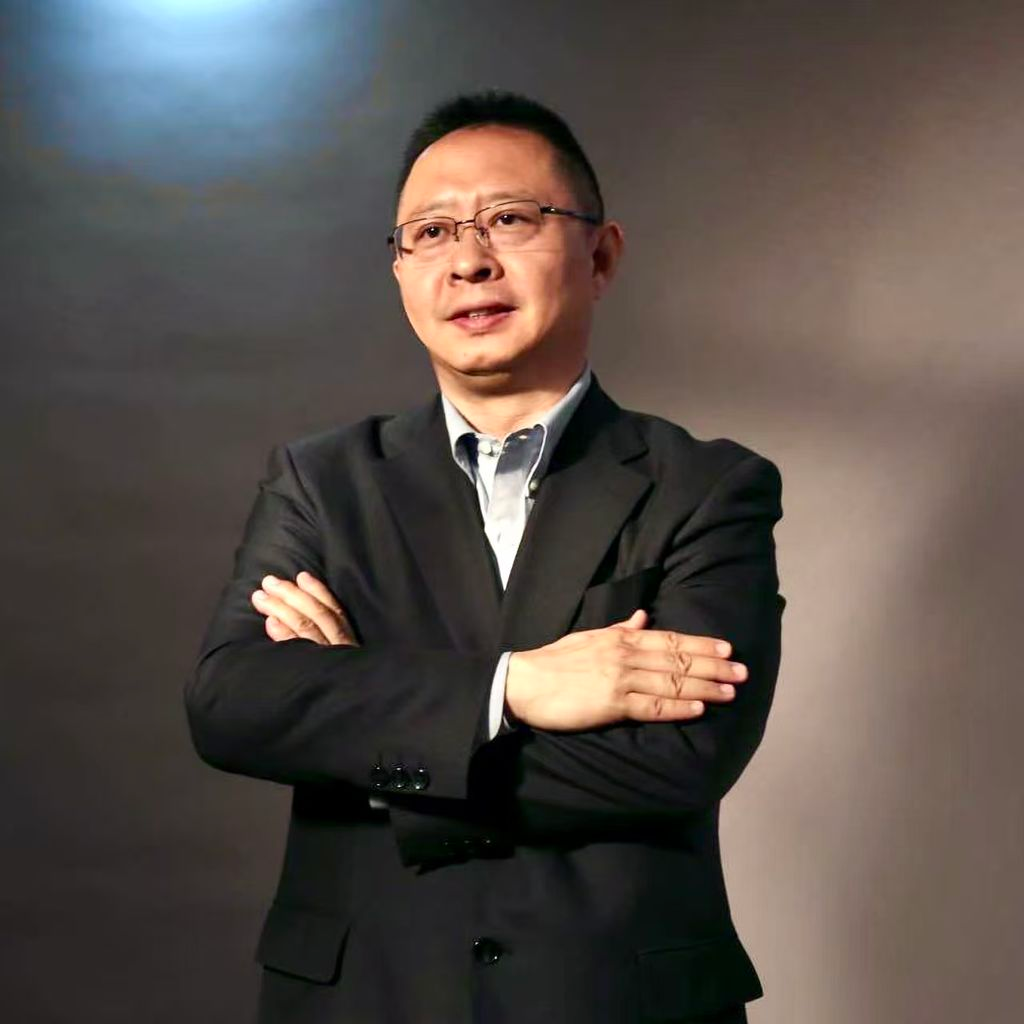
Today we publish the first article, and the guest speaker isWang Xiaolong, Chairman of Beijing Cuncao Chunhui Elderly Care Service Management Co., Ltd., and the speech topic is‘One Bed, Fifteen Years of Care — Three-in-One: Cuncao Chunhui Building a National Chain Elderly Care Brand Driven by the Dual Wheels of ‘Quality + Profitability”.
Wang Xiaolong
Chairman of Beijing Cuncao Chunhui Elderly Care Service Management Co., Ltd.
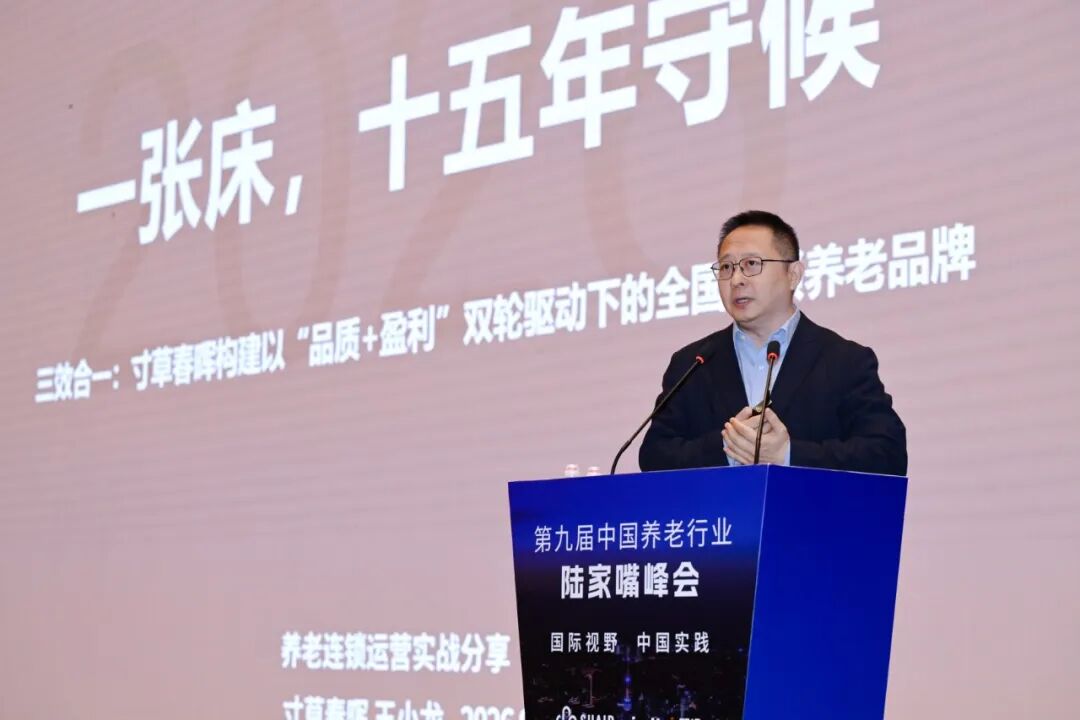
Hello everyone, I am Wang Xiaolong, Chairman of Cuncao Chunhui. The topic I will share with you today is ‘One Bed, Fifteen Years of Care.’
Cuncao Chunhui has been in elderly care for fifteen years, growing from one facility to twenty. In an environment where the industry average occupancy rate is about 50%, we have achieved purely market-driven operation and profitability.
Today I want to condense fifteen years of experience into three aspects to share with you:
First, balancing quality and operations to solve the pain points of industry development;
Second, implementing cross-city chains, achieving scale expansion through refined operations;
Third, deeply cultivating brand and employee culture to solidify the foundation for long-term chain development.
Balancing Quality and Operations
Solving the Pain Points of Industry Development
Our elderly care industry generally faces a common dilemma—’high-end does not profit, profitable is not high-end.’ The key to breaking this dilemma lies in breaking the mindset of ‘quality equals cost’ and embedding business logic into the entire service chain. How specifically to do this? We have summarized three points: moderate trade-offs, calculation in advance, and win-win cooperation.
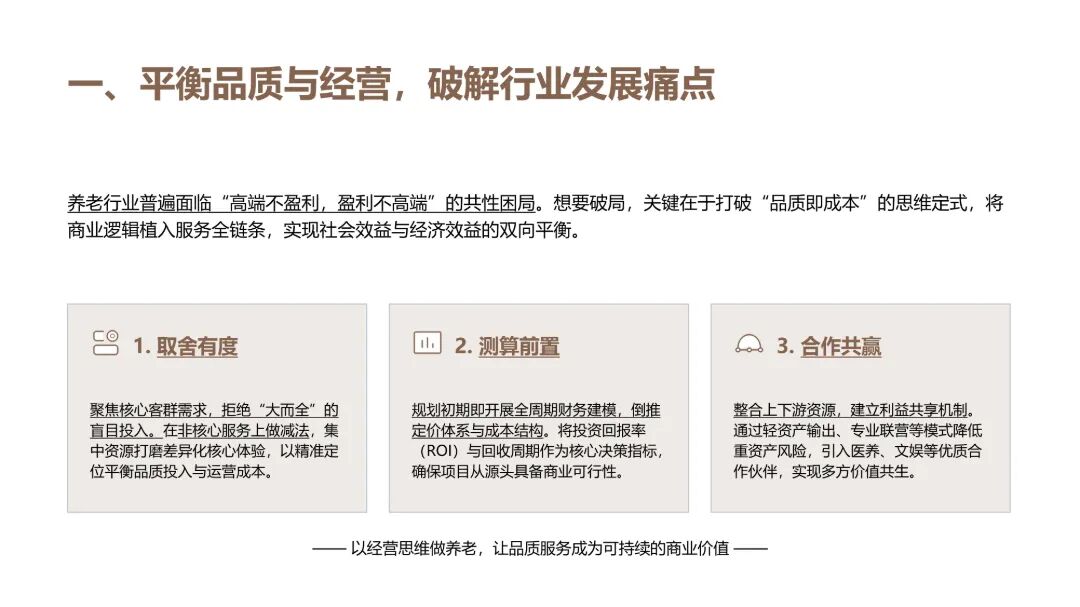
The first point, moderate trade-offs: precisely select projects, learn to focus, and dare to say no.
Enterprises have inherent limits to their capabilities; taking on projects blindly will only dilute professional strength and lower service quality.There are three types of projects we firmly will not touch:
-
The first type is structural hard defects—properties where building structural renovation is extremely difficult and there are irreversible safety hazards. Forced renovation costs are enormous, so they must be handled with caution.
-
The second type is cost imbalance—projects where financial calculations cannot achieve payback and the input-output ratio is severely unbalanced. We hold to our commercial bottom line and do not blindly enter just because of the temptation of scale.
-
The third type is ideological conflict—cross-industry projects in unfamiliar tracks, or partnerships where the client ignores industry professional standards and keeps lowering the service bottom line. We absolutely cannot compromise.
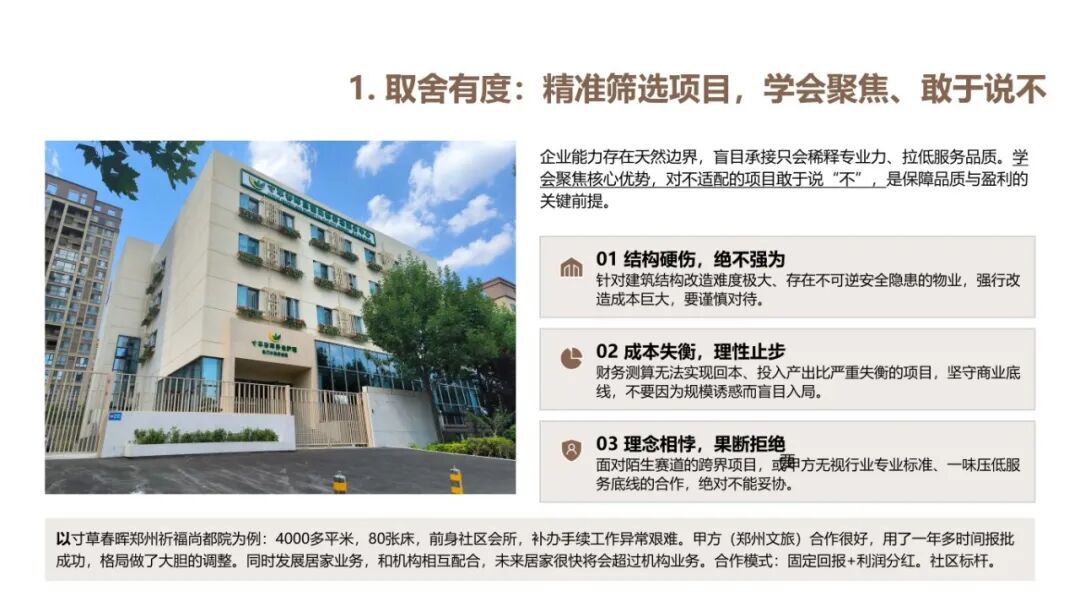
For example, our Zhengzhou Qifu Shangdu Institution has more than 4,000 square meters and 80 beds. It was formerly a community clubhouse with a swimming pool and badminton hall, and completing the paperwork was extremely difficult. But our partner, Zhengzhou Cultural Tourism Group, was excellent. They spent more than a year persistently pushing through approvals and made bold adjustments to the layout. At the same time, we developed home-based services to complement the institution, and in the future home-based services will soon surpass the institution. The cooperation model is fixed returns plus profit sharing, and it has now become a community benchmark.
Second, calculation first: pre-renovation financial calculation plus professional planning, with no compromise on standardized construction.
The core logic is putting operational needs first.We have seen too many projects where overly optimistic preliminary calculations led to them becoming unfinished for ten or even fifteen years, or continuously losing money. Therefore, before implementation, a full-dimensional, full-scope financial model must be completed to clearly and thoroughly calculate the client’s payment capacity and the entire project’s costs.
At the same time, the real needs of frontline care and operations should be used as the benchmark, repeatedly refining spatial circulation, supporting layout, and details.The design of one of our projects must go through 20 to 30 rounds of discussion, because only operations knows what it wants. A common problem among many large enterprises is that leaders have never worked in elderly care before, transferred from other industries, or real estate bosses and restaurant owners suddenly say they want to do elderly care, thinking it is simple, but without professional people doing planning from an operations perspective, problems are bound to arise in the end.
Another point is especially important: adhere to the bottom line of standardized construction, resolutely do not cut costs on age-friendly facilities and service support, and especially pay attention to the quality of concealed works.Why? Because the lower your routine maintenance costs, the higher your ten-year profit. Secondary renovation is very troublesome, all pipelines need to be relaid, and the longer you delay, the higher your profit. Therefore, concealed works must be done thoroughly, and that is profit.
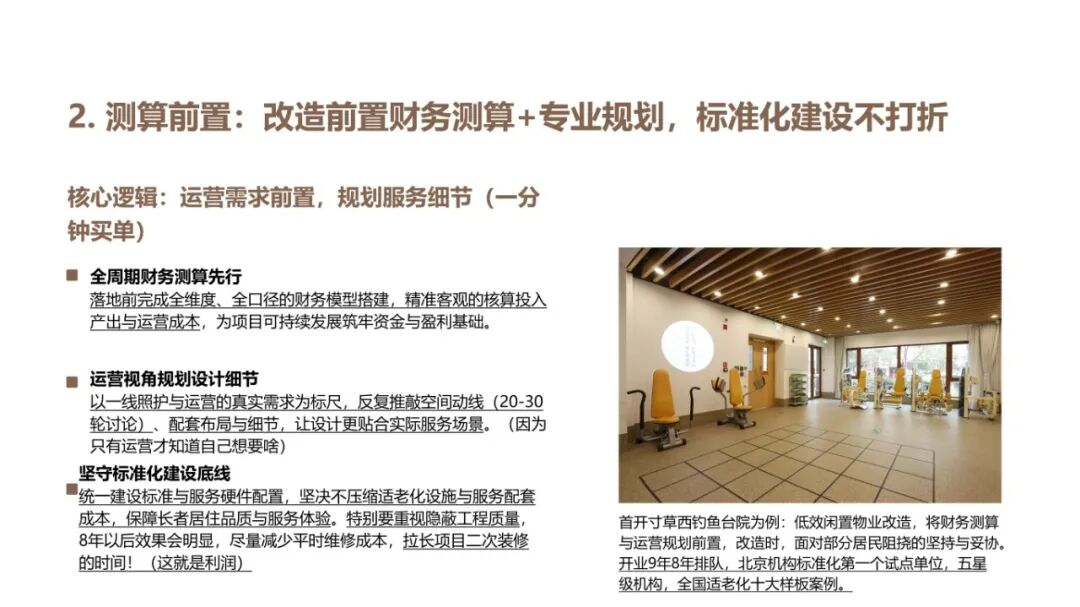
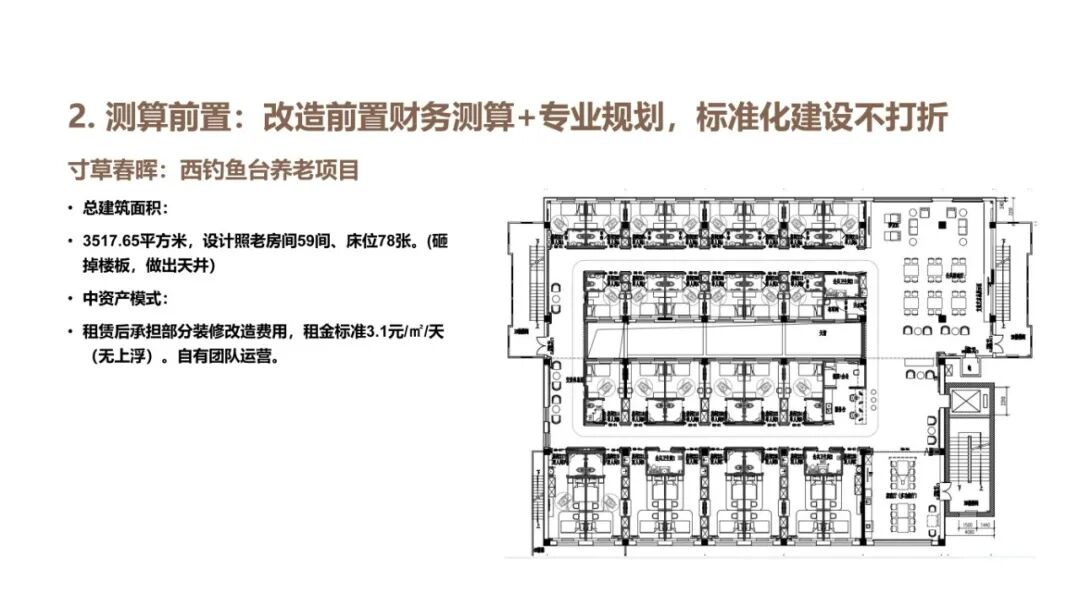
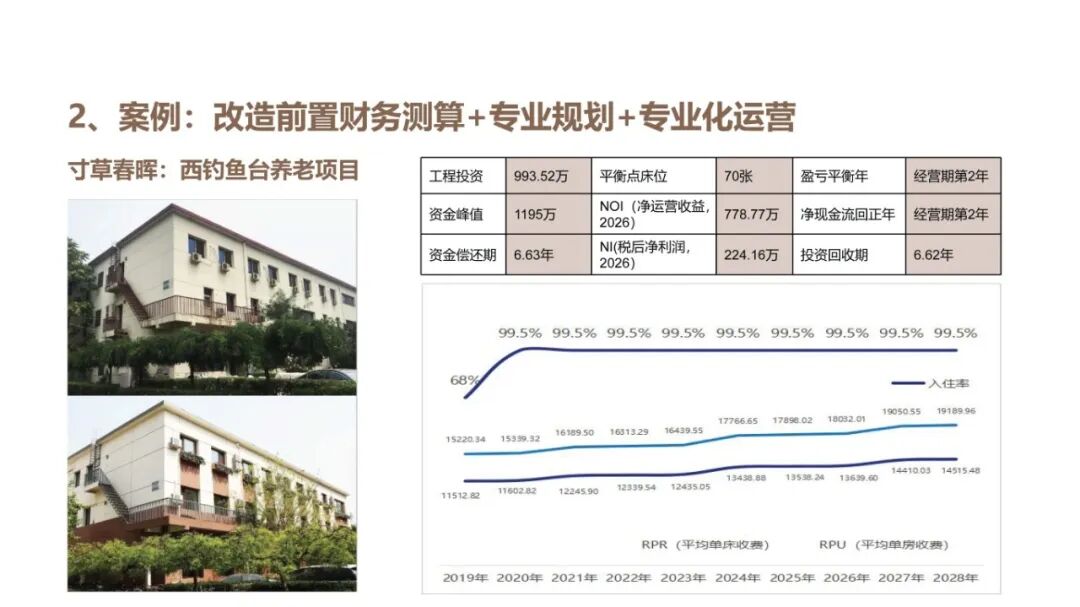
Our Xidiaoyutai facility is a typical case: 3,517 square meters, 78 beds, medium-asset model, rent of 3.1 yuan per square meter per day, open for nine years, fully occupied with a waiting list for eight years, the first pilot unit for institutional standardization in Beijing, a five-star institution, and one of the top ten national model cases for age-friendly design.
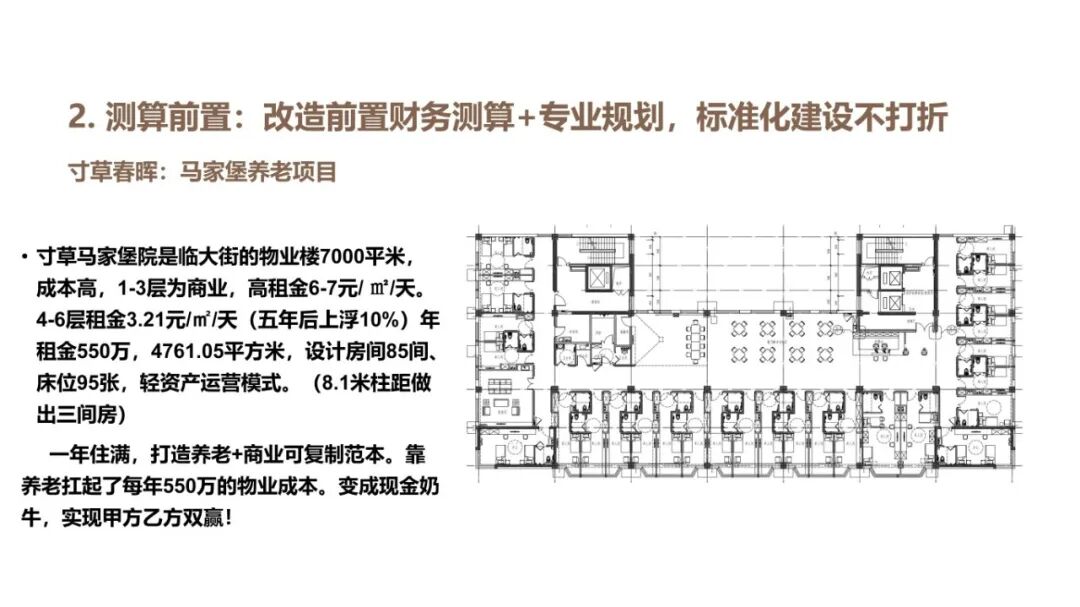
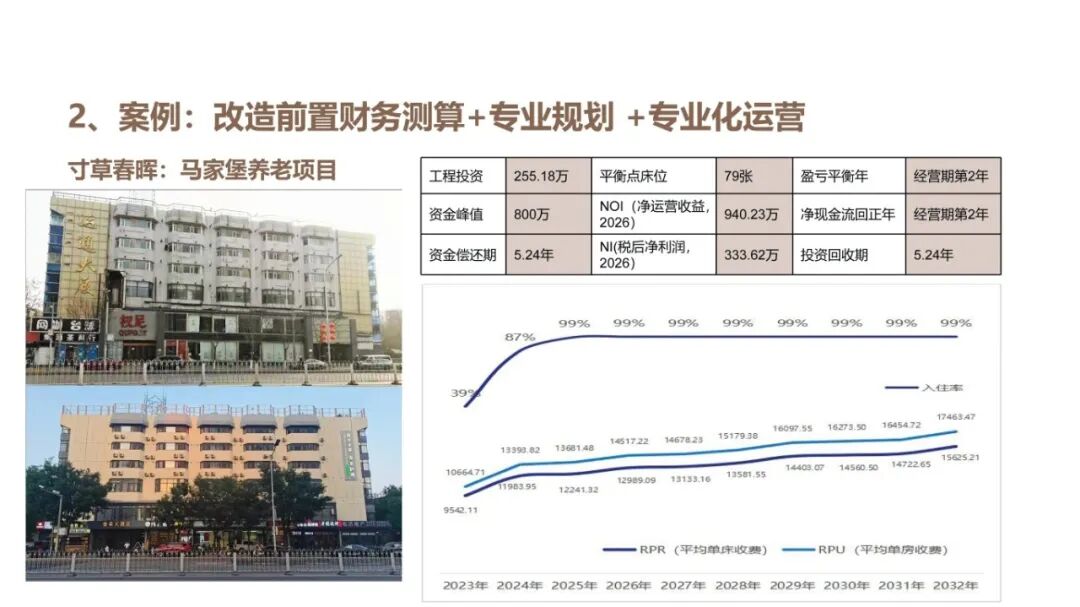
There is also the Majiapu facility, located on floors 4 to 6 of a street-facing commercial building, with annual rent of 5.5 million yuan, 95 beds, light-asset operation, fully occupied within one year, using elderly care to cover the annual property cost of 5.5 million yuan, turning into a cash cow and creating a win-win for both Party A and Party B.
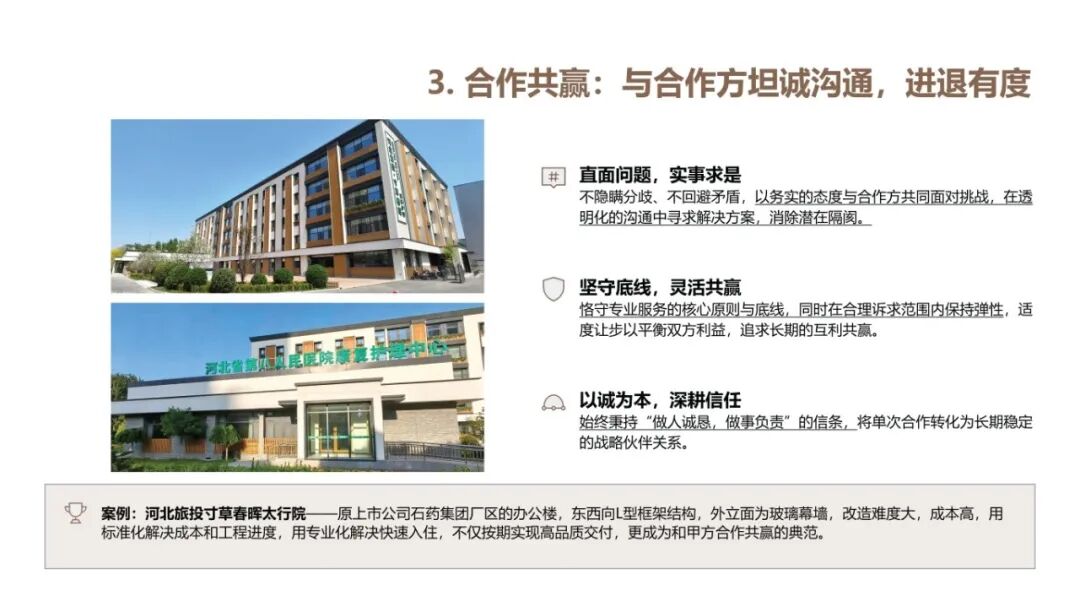
No.Three principles for win-win cooperation: with partners,communicate candidly and know when to advance or retreat.
Face problems directly and be realistic and truthful, concealing no differences and avoiding no contradictions. Hold the bottom line while remaining flexible for win-win outcomes: compromise when compromise is due, and persist when persistence is due. Our philosophy is to be sincere in character, responsible in work, and to do things well and succeed at each one. For example, the Hebei Tourism Investment Cuncao Chunhui Taihang Institution was originally an office building in the Shijiazhuang Pharmaceutical Group factory area, an east-west L-shaped frame structure with a glass curtain wall facade, making renovation difficult and costly. We used standardization to address cost and construction progress, and specialization to achieve rapid occupancy. Not only did we deliver high quality on schedule, but it also became a model of win-win cooperation with the client.
Cross-city chain expansion
Achieving scale expansion through refined operations
From one store to twenty stores, overcoming the “unfamiliar environment” of operating in other locations, we also relied on three things: building a standardized system, cultivating localized talent, and adhering to long-termism.
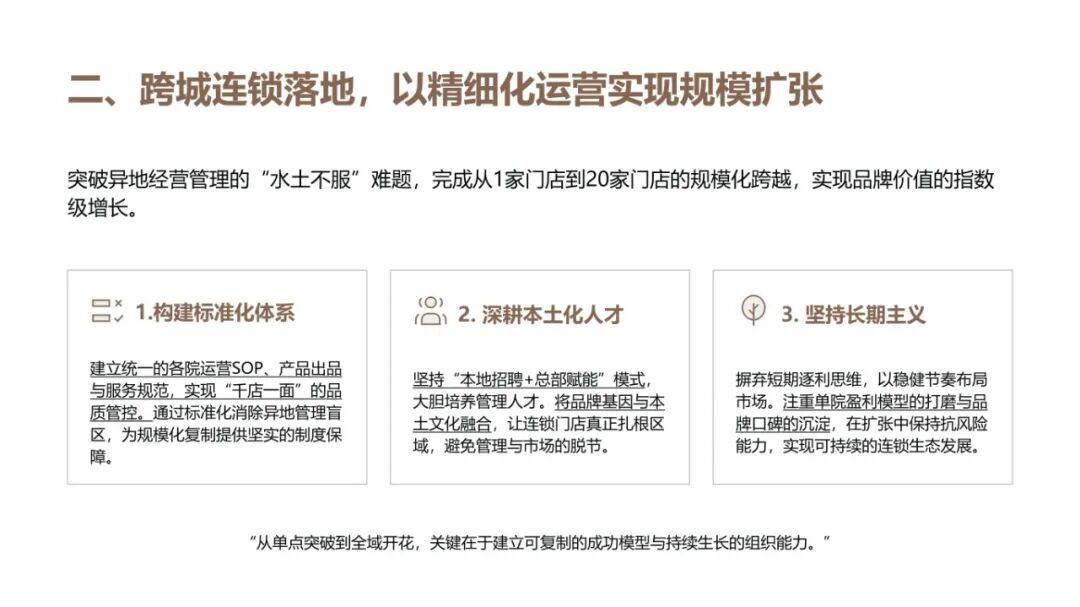
First, build a standardized system: full-process standardized management and control, anchored to the “integration of three efficiencies.”
This is what I especially want to emphasize today.Three effects in one means improved efficiency, enhanced quality, and increased benefits.Many people ask me how to do cost optimization. Is it reducing staff to increase efficiency? Is it cutting consumable costs? We do all of these, but I think the most reliable approach is to improve efficiency. Lose one less employee, have one less elderly person fall, reduce one accident, and the money comes out—in the long run, the money comes out. Improving efficiency and achieving the three effects in one is the best cost optimization strategy.
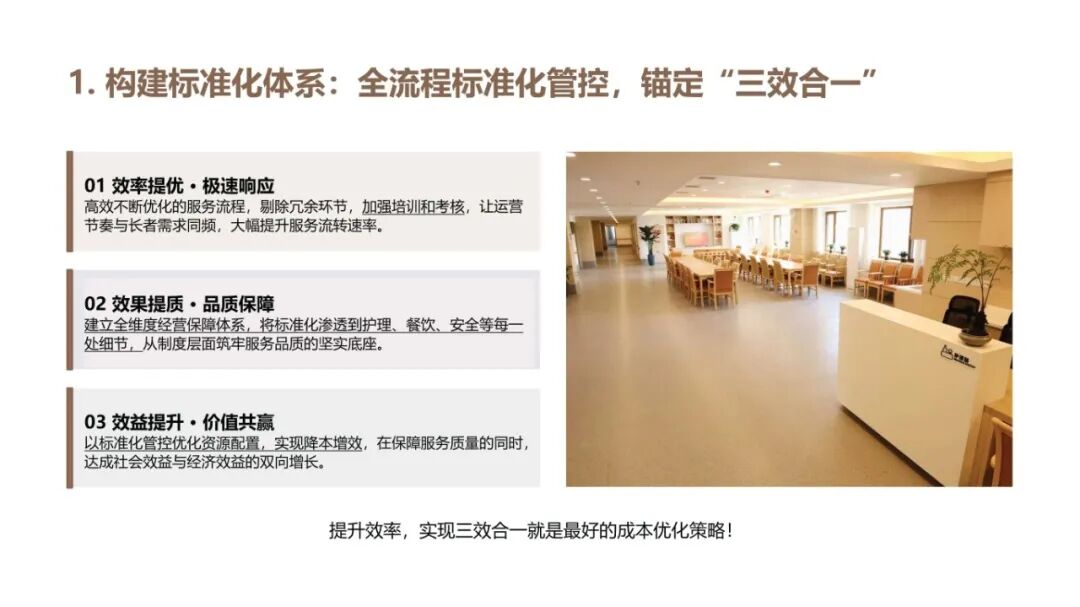
Cuncao Chunhui is the enterprise that has participated the most in formulating national and industry standards for the elderly care industry. It has participated in the writing of and published a total of 16 standards, including 11 national standards, 3 industry standards, and 2 local standards.
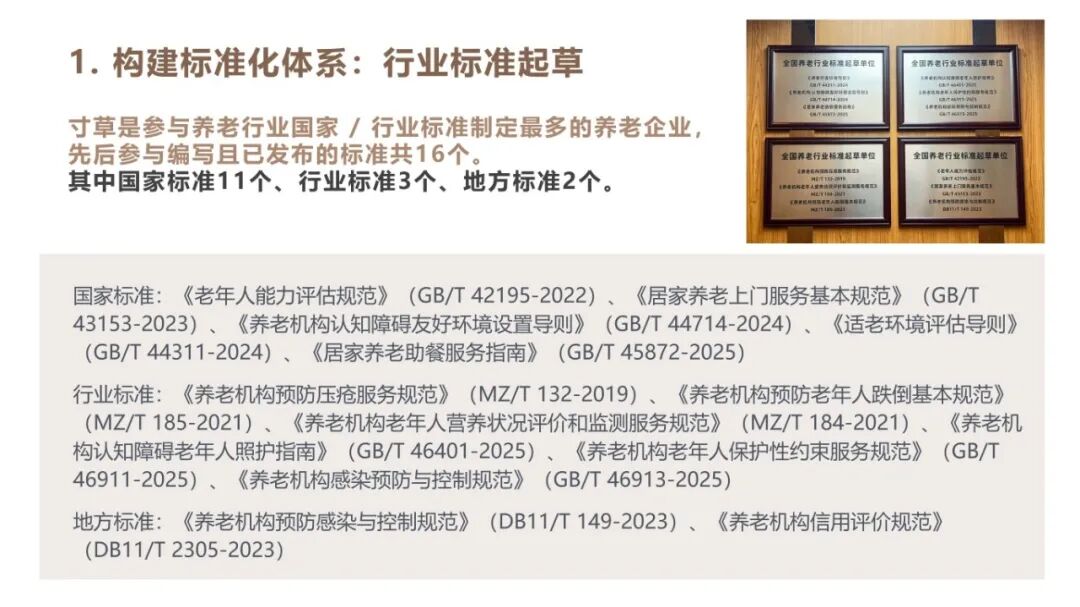
Second, deeply cultivate localized talent: independently cultivate talent and build a middle-level backbone echelon.
For cross-provincial chains, you cannot always send people from Beijing. Hebei, Henan, Shanxi and other places are different after all.So we adhere to ‘local recruitment plus headquarters empowerment’ and boldly cultivate management talent.We pay special attention to selecting and cultivating the waist strength, with middle-level management cadres as the focus of training. At the same time, we boldly use newcomers, preferring high-potential newcomers with zero foundation. Their stronger plasticity and learning ability allow them to integrate and innovate faster than old employees with fixed experience. We promoted cooks to nursing home directors and cultivated young people into backbones. In the short term, the cost is high; in the long term, the cost is low. We make training the greatest welfare. Cuncao Chunhui’s backbone team is one of the most stable teams in China’s elderly care industry.
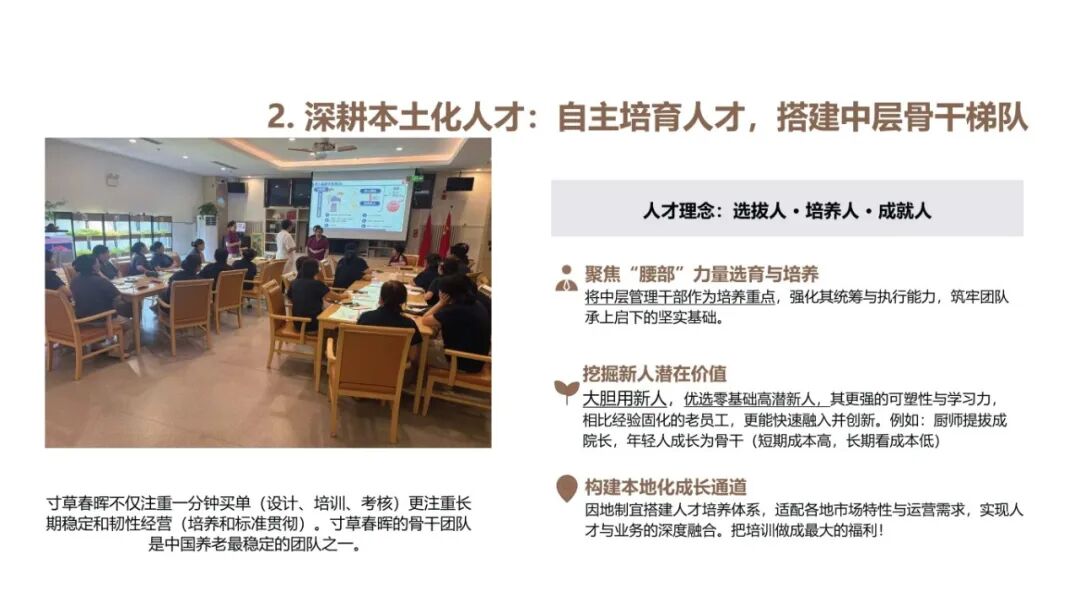
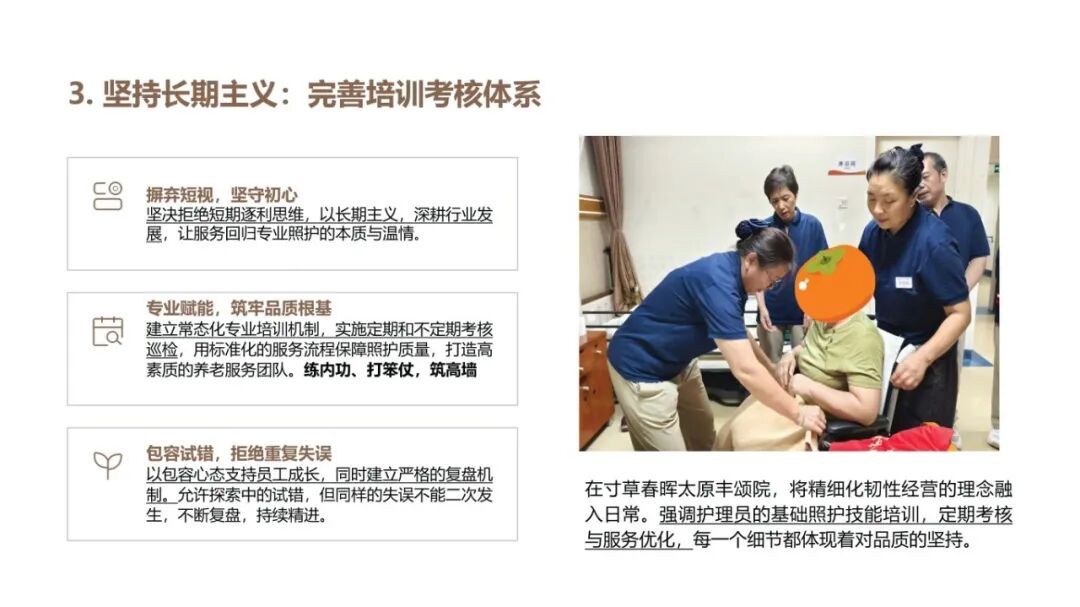
Third, adhere to long-termism: improve the training and assessment system.
Resolutely reject short-term profit-seeking thinking, and commit to the industry with long-termism.Establish a regular professional training mechanism, and implement both scheduled and unscheduled assessments and inspections.I always say that you must explain things clearly and thoroughly to employees. Once they understand, they won’t make mistakes. Once they understand, one fewer person will stumble, one fewer fall will happen, and our costs will come down. So we must practice internal skills, fight clumsy battles, and build high walls. At the same time, support employee growth with an inclusive mindset, allow trial and error in exploration, but the same mistake must not happen twice. Keep reviewing and continuously improve.
Deeply cultivate brand and employee culture
Build a solid foundation for the long-term development of the chain
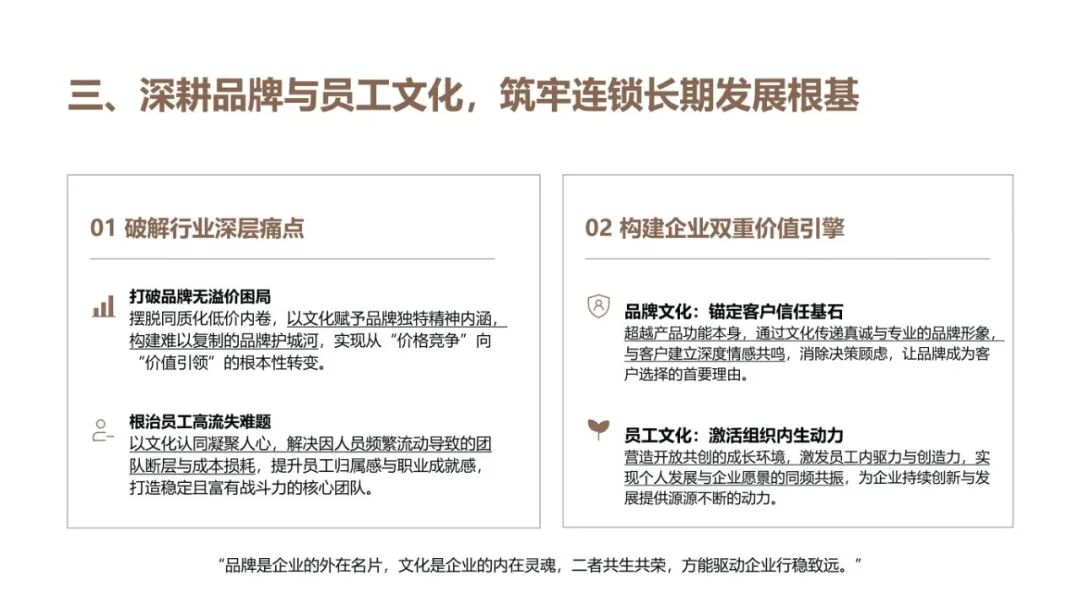
Brand is the external business card of an enterprise, and culture is its internal soul. We build two major cultures: brand culture anchors the cornerstone of customer trust, and employee culture activates the organization’s internal driving force.
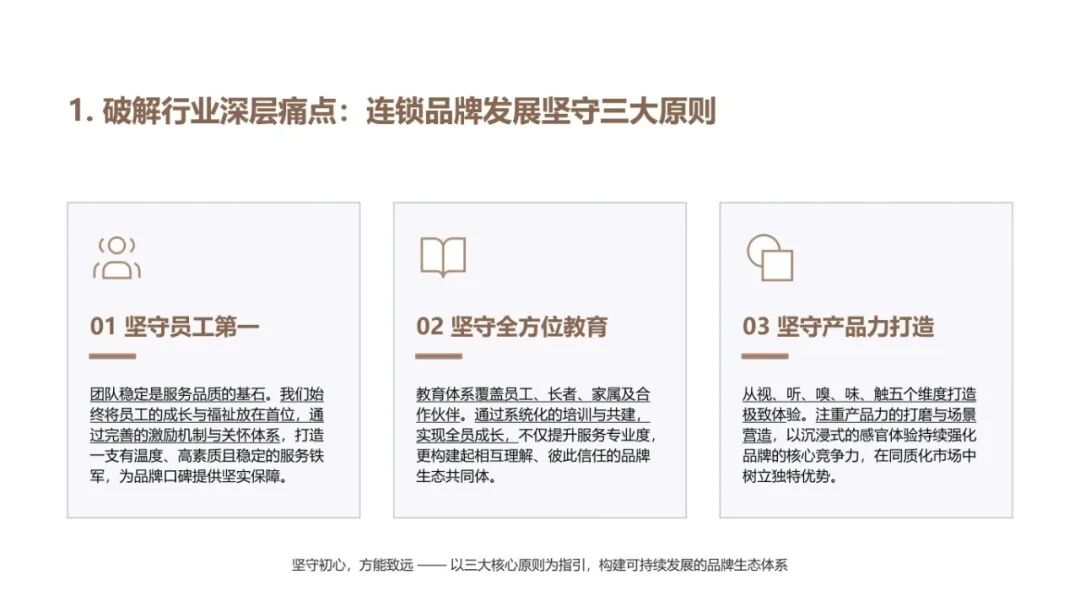
The development of a chain brand adheres to three major principles:
First, uphold employees first.Team stability is the cornerstone of service quality. We always put employee growth and well-being first. Whether at headquarters or in management meetings at each facility, we must always consider the interests of employees.
Second, remain committed to all-round education. The education system covers employees, seniors, family members, and partners. We cannot educate only employees, nor only seniors; we must enable everyone to resonate with us and grow together.
Third, remain committed to building product strength.We create an ultimate experience across the five dimensions of sight, hearing, smell, taste, and touch. Specifically: visual beauty, creating comfortable, tidy, warm, and elegant age-friendly aesthetic spaces; a sense of status, providing tiered exclusive services and customized benefits; a sense of belonging, fostering a warm community atmosphere so seniors can regain the warmth of a big family; emotional pleasure, offering diverse cultural and recreational activities supplemented by professional psychological counseling; and a sense of value and fulfillment, combining the concept of use it or lose it so seniors can rediscover life’s value through learning and contribution.
Finally, let me use two financial data points as supporting evidence.
At the Xidiaoyutai facility, the engineering investment was 9.93 million yuan, the break-even point is 70 beds, it broke even in the second year of operation, and the investment payback period is 6.62 years.
At the Majiapu facility, the engineering investment was 2.55 million yuan, the break-even point is 79 beds, it also broke even in the second year, and the investment payback period is 5.24 years. Efficient investment and excellent service can definitely achieve a win-win outcome for both Party A and Party B.
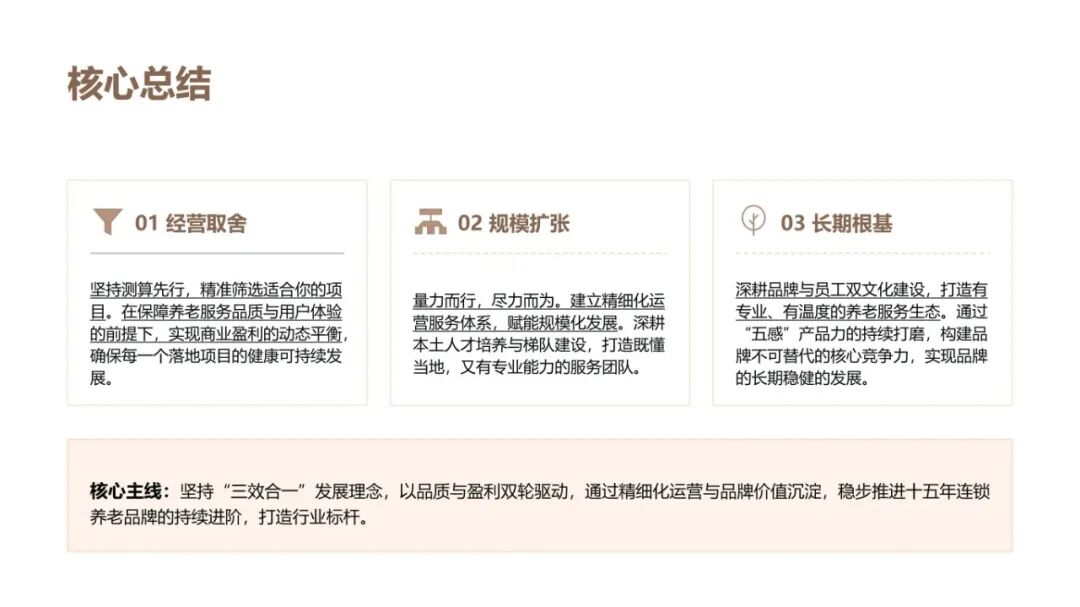
To summarize:
-
In terms of business trade-offs, adhere to calculation first and precisely select projects that suit you;
-
In terms of scale expansion, act according to your capacity while striving to do your best, and establish a refined operational service system;
-
In terms of long-term foundations, deeply cultivate both brand and employee culture, and build a professional and warm elderly care service ecosystem.
The core thread is to adhere to the ‘three effects in one’ development philosophy, driven by both quality and profitability, and steadily advance the continuous progression of a fifteen-year chain elderly care brand.
Wang Xiaolong
Chairman of Beijing Cuncao Chunhui Elderly Care Service Management Co., Ltd., Ph.D. in Social Security from the Chinese Academy of Social Sciences, representative of the Chaoyang District People’s Congress in Beijing, member of the National Expert Committee on Elderly Care Services, member of the National Social Welfare Standardization Committee, specially appointed elderly care consultant for the Asian Development Bank, national advanced individual in elderly care services, specially appointed professor at the School of Social Development and Public Policy of Beijing Normal University and the Department of Elderly Service and Management of Beijing Vocational College of Labor and Social Security. He has published multiple research results on China’s community elderly care in core journals and has participated in the review and revision of more than ten national and industry standards.
|
Source: Amu Senior Care Disclaimer: This platform is dedicated to industry sharing and exchange; articles do not represent the platform’s views. Copyright belongs to the original author. If the source attribution is incorrect or your legal rights are infringed, please contact us and we will promptly correct or delete it. Thank you. |